Leave, Payslips and Policy Questions by Text: A No-Code iMessage AI Agent for HR Teams
See how a no-code iMessage AI agent can answer leave, payslip, policy and onboarding questions using live HR data, approved knowledge and clear access controls.
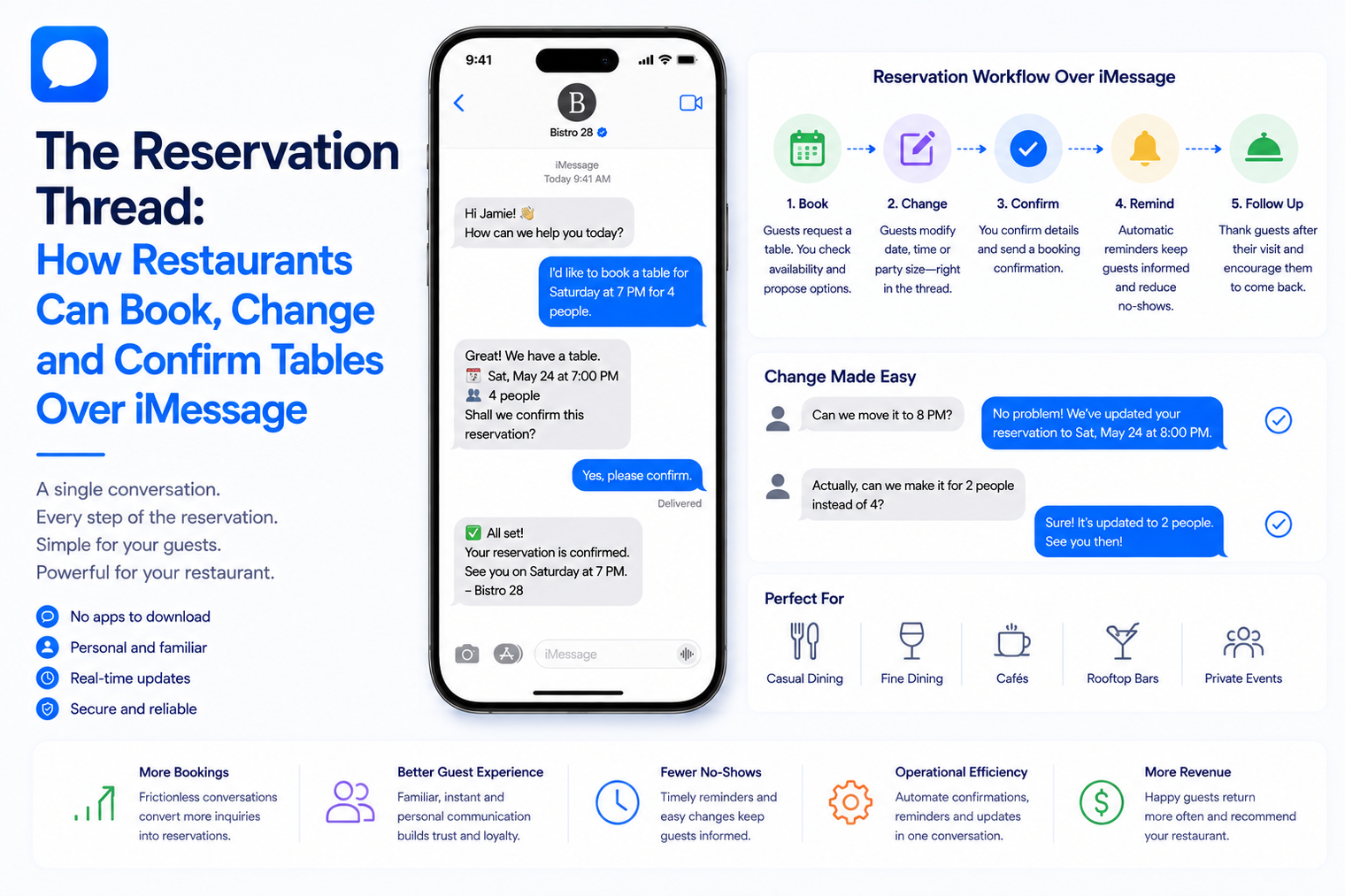
· A reservation agent should read live availability before offering a time and write every confirmed change back to the same scheduling system staff use.
· Natural-language understanding is useful for requests such as "make it an hour later," but capacity, seating and policy decisions should remain rule-driven.
· The workflow should support the full reservation lifecycle: new bookings, changes, cancellations, reminders, waitlists and pre-arrival questions.
· Human handoff is essential for large parties, special events, complex accessibility needs, complaints and exceptions to restaurant policy.
· The best success metrics are completed bookings, saved reservations and reduced phone workload, not the number of automated messages sent.
Restaurant reservations are rarely a single transaction. Guests change the time, add a person, ask about outdoor seating, arrive late, cancel, join a waitlist or need an answer about a policy before they commit. A booking form can capture the original reservation, but it is not always good at handling what happens next.
An iMessage reservation workflow turns those changes into a conversation. The guest texts the restaurant, the system checks real availability, collects the minimum details needed and writes confirmed changes back to the scheduling source. An AI layer can interpret natural language, while deterministic booking logic protects capacity, timing and business rules.
People may search for an "iMessage reservation bot," but the better product model is an agent with boundaries. It should know what it can book automatically, what needs clarification and what belongs with a host or manager. The result is not a bot replacing hospitality. It is a thread that handles routine coordination so staff can focus on guests who are in front of them.
Online booking solved one part of the restaurant phone problem: finding an available table and capturing the first reservation. But the lifecycle of that reservation still generates calls, voicemails and manual edits. Guests ask to move the time, change party size or confirm whether a special request was seen. Staff answer while checking a screen, then update the booking record separately.
That creates two sources of friction. Guests have to find the right channel, and staff have to translate a conversation into system changes. A messaging workflow can close the gap if the thread is connected to live scheduling data rather than a static FAQ.
MessageBlue currently supports scheduling-oriented agent workflows through its integration layer. A restaurant can use an iMessage appointment bot pattern for booking and rescheduling while keeping the actual calendar or reservation system as the source of truth.
| Guest intent | What the agent needs | Safe automated result | Human handoff trigger |
|---|---|---|---|
| New booking | Date, time, party size, live availability | Offer valid options and confirm the selected table or reservation slot | Large party, event request or unavailable policy exception |
| Change time or date | Existing reservation and current availability | Move the booking and release the old slot only after confirmation | No suitable alternative or conflicting reservation record |
| Change party size | Existing reservation, capacity and table rules | Approve when the reservation engine confirms capacity | Increase changes seating plan or exceeds automatic limit |
| Cancellation | Reservation identity and cancellation rules | Cancel, release capacity and confirm completion | Deposit, fee or disputed cancellation policy |
| Waitlist | Desired window, party size and contact identity | Add to waitlist and notify when a valid slot becomes available | Special event, complex seating need or manual prioritization |
| Guest question | Approved restaurant knowledge | Answer hours, parking, dress code or general policy questions | Medical, allergy or exception request that needs staff judgment |
The first job is simple: convert an unstructured message into the fields required for a reservation. A guest might text, "table for four Friday around 8." The agent should extract party size, date and preferred time, then query live availability.
If 8:00 is not available, it should offer real alternatives instead of inventing a waitlist or promising a table. If the guest says "later," the system should understand the context of the current options and query again. This is where conversational AI helps: it handles natural language while the scheduling system controls what is actually bookable.
The messaging layer can be powered by an iMessage AI agent that receives the guest's text, calls the relevant booking or calendar tool and sends the answer back into the same thread.
Changing a reservation is more sensitive than creating one because a bad workflow can release the wrong table or create a duplicate booking. The agent should identify the existing reservation first, then treat the change as a small transaction with a clear before and after state.
For a reschedule, do not cancel the original reservation before the replacement slot is verified. Hold or confirm the new option according to the reservation system's rules, then update the booking and report the final state. For a cancellation, repeat the reservation details and ask for confirmation when fees, deposits or unusual policies apply.
This approach is less flashy than a free-form chatbot, but it is safer. The AI interprets "push us to 8:30" and keeps the conversation natural. The booking logic determines whether 8:30 exists and whether the old reservation can be changed.
A reminder is most useful when the guest can act on it. Instead of a one-way message that says "See you tomorrow," the workflow can invite a simple confirmation or change request. If the guest cannot make it, the same thread can offer alternatives and update the booking immediately.
The operational value is not only fewer no-shows. A fast cancellation can release capacity early enough to refill the table. A fast reschedule can preserve the guest relationship instead of turning a conflict into a lost booking.
Keep reminder timing and frequency conservative. The goal is coordination, not repeated promotion. The message should identify the restaurant, state the reservation clearly and make the next action easy to understand.
Waitlists are a natural fit for messaging because availability changes in real time. A cancelled table creates a short window in which the restaurant needs a quick response from a guest who already expressed interest.
A strong workflow stores the requested date, time window and party size. When a matching slot opens, it contacts the eligible guest according to the restaurant's rules, gives a clear response window and confirms the reservation only after the guest accepts.
Avoid race conditions. If several guests are contacted, the system must know whether the table is temporarily held, first-come-first-served or manually assigned. This logic belongs in the reservation system or application layer, not in the language model.
Guests often ask questions that influence whether they keep a reservation: parking, opening hours, corkage, outdoor seating, stroller access, dress code or whether the restaurant can accommodate a request. Many of these can be answered from approved business knowledge.
Some questions need caution. Allergy and medical-safety questions should not be answered from a generic model guess. If the restaurant has an approved policy or kitchen process, the agent can state it accurately and offer a human handoff for specific needs. The same principle applies to large events, private rooms and exceptions to published rules.
For straightforward workflows, a no-code iMessage AI agent can combine instructions, approved knowledge and connected scheduling tools. More complex restaurants may prefer custom logic for table rules, deposits, loyalty data and multi-location routing.
A reservation agent fails quickly if it offers stale times. The scheduling source must be queried at the moment the guest asks, and confirmed bookings must be written back immediately so staff and automation see the same state.
Avoid maintaining a separate shadow calendar for the agent. Two systems that both believe they own availability create double booking risk and confusing staff handoffs. The messaging interface should sit on top of the restaurant's real booking data, not beside it.
The same rule applies across locations. If a group has several restaurants, the agent needs to know which location the guest means before showing availability. Location should be a first-class piece of conversation state, not an assumption inferred from a previous message without confirmation.
Hospitality is relationship-driven. A familiar number can reduce confusion when the restaurant already uses it for confirmations, guest questions or direct contact. MessageBlue's automate existing iMessage number workflow is designed for cases where automation and normal manual texting need to coexist on the same line.
That coexistence matters during service. The agent can handle routine booking changes, then a host can take over the same thread for a VIP request, a delayed arrival or a complaint. The customer does not need to switch channels, and staff do not have to move the conversation into a separate inbox before replying.
Automation should make hospitality staff more available, not less reachable. Define handoff rules before launch and make the transition explicit to both the guest and the team.
· Large parties, buyouts, private dining and event inquiries that need pricing or custom seating.
· Allergy, accessibility or special accommodation requests that require confirmation from staff.
· Deposit disputes, cancellation-fee disputes and complaints about a previous visit.
· Requests that depend on table placement, celebrity or VIP handling, or other judgment-based decisions.
· Repeated misunderstanding, low-confidence intent or a direct request to speak with a person.
When handoff occurs, pass the reservation details, the guest request and what the automation already tried. Pause the agent until the human resolves the conversation or explicitly returns it to automation.
1. Choose the reservation system of record: Decide exactly where live availability, confirmed bookings, cancellations and waitlist state live. The messaging workflow should never compete with it.
2. Define the intents you will automate: Start with new reservations, simple reschedules and cancellations. Add waitlists and more complex guest service only after the core lifecycle is reliable.
3. Write the booking rules: Document party-size limits, time windows, deposits, cancellation rules, seating constraints and when staff approval is required.
4. Connect conversation state to reservation state: Store the reservation identifier, location, date, time and party size so each follow-up message is interpreted in the correct context.
5. Test failure cases during real service conditions: Test fully booked periods, simultaneous cancellations, duplicate messages, late-night changes, ambiguous dates and a staff member taking over manually.
6. Measure saved work and guest outcomes: Track successful self-service changes, recovered bookings, phone calls avoided, staff handoffs and unresolved conversations. Expand only where the data supports it.
· Booking completion rate from the first guest message.
· Percentage of reschedule requests completed without a staff call.
· Cancellations captured early enough to release capacity.
· Waitlist offers that turn into confirmed reservations.
· Average time to resolve a routine reservation question.
· Human handoff rate and the reasons behind it.
· Phone call volume during peak service periods.
· Guest satisfaction with the booking and change experience.
No-code works well when the scheduling system, knowledge and rules fit the available connectors. A restaurant group or hospitality product may need a custom application when it has proprietary table optimization, deposits, loyalty tiers, multi-location routing or custom event logic.
In that case, programmable iMessage gives the application a two-way messaging layer. Inbound messages can trigger your own reservation logic, and the application can send the confirmed result back to the guest without giving up control of the booking engine.
The architecture should still follow the same principle: conversational understanding in the agent, business truth in the reservation system, deterministic rules for capacity and money, and human judgment for exceptions.
The most valuable reservation automation is not the message that confirms a table. It is the thread that makes the next change easy. A guest who can move a booking in seconds is less likely to disappear, and a restaurant that learns about a cancellation early has more time to refill the capacity.
Start with one reservation lifecycle, connect it to live availability and make the handoff to staff effortless. Once that workflow is reliable, iMessage can become a practical front door for booking, changes and guest coordination without turning hospitality into a scripted chat experience.
Yes, if the agent is connected to a reservation or scheduling system that exposes current availability and allows the workflow to create a booking. The restaurant should define which bookings can be completed automatically.
Yes. The workflow should identify the existing reservation, query new availability, confirm the replacement and update the same booking record rather than creating a duplicate.
Yes, with clear rules. The system needs to store the guest's preferred window and party size, then control how released capacity is offered and reserved.
It should only state approved restaurant information and should escalate specific medical or allergy-safety questions that need staff confirmation. It should never invent a safety guarantee.
Yes. The handoff should pause automation, preserve the full thread and clearly show the staff member what the guest is asking and which reservation is involved.
Not necessarily. Where supported, an existing iMessage number can be made programmable so automation runs alongside normal staff texting.
Simple rescheduling is a strong starting point because the intent is clear, the result is measurable and it can reduce phone calls without requiring the agent to make subjective hospitality decisions.
Connect any LLM to a real blue-bubble number and go live in minutes.
Deploy an Agent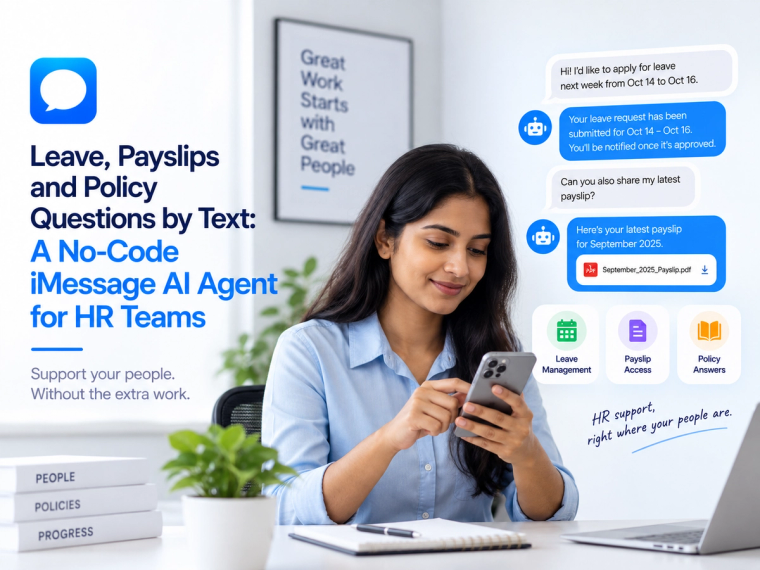
See how a no-code iMessage AI agent can answer leave, payslip, policy and onboarding questions using live HR data, approved knowledge and clear access controls.
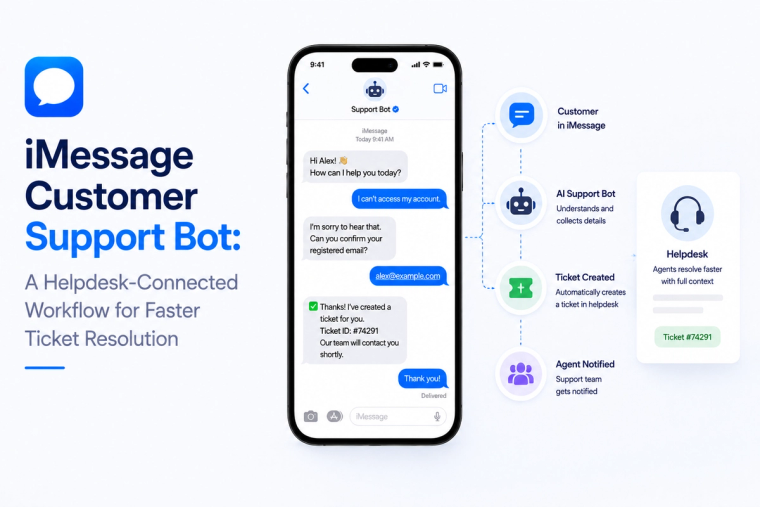
Design an iMessage customer support bot that reads helpdesk data, creates tickets, handles status questions and escalates complex cases with full conversation context.
Evaluate iMessage API data residency across message content, logs, backups, keys, model providers, integrations and deployment boundaries before enterprise rollout.