Leave, Payslips and Policy Questions by Text: A No-Code iMessage AI Agent for HR Teams
See how a no-code iMessage AI agent can answer leave, payslip, policy and onboarding questions using live HR data, approved knowledge and clear access controls.

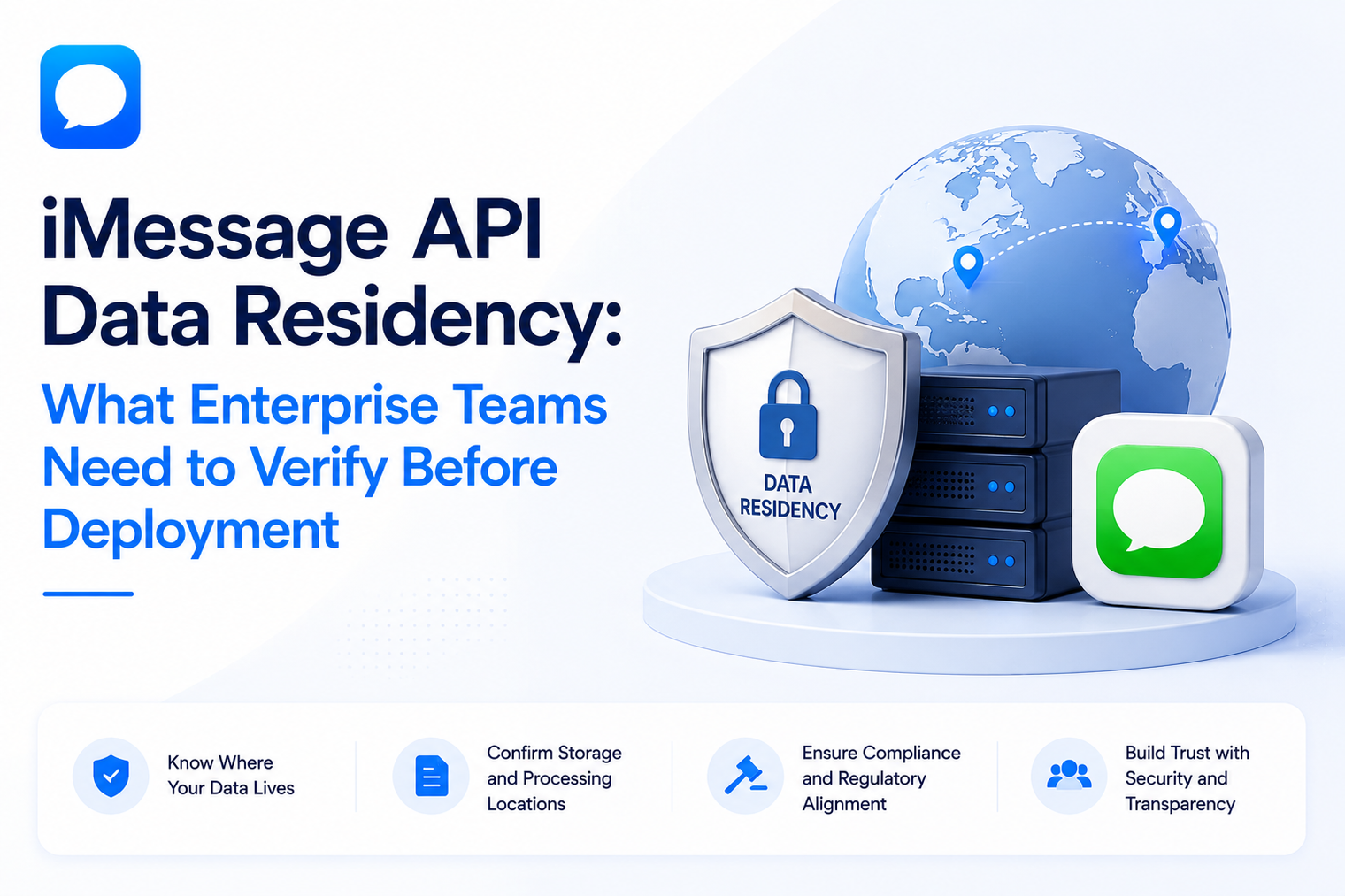
· Data residency must cover message content, metadata, logs, backups, credentials, observability and connected services, not only the primary database.
· Private managed cloud, BYOC and on-premises deployments create different control boundaries and different operating responsibilities.
· Customer-managed encryption keys improve control, but key location, rotation, recovery and administrative access still need to be reviewed.
· AI model providers and business integrations can create separate data flows outside the messaging runtime unless the architecture restricts them.
· The final residency position should be documented as a data-flow map and shared-responsibility model that security, legal, engineering and the vendor can all review.
A vendor can say “your data stays in region” and still leave an enterprise security team with unanswered questions. Message content may live in one location while logs, backups, model requests, support tooling or connected business applications travel somewhere else. For a messaging system, data residency is therefore a data-flow question, not a checkbox.
An iMessage API data residency review should trace every class of information from the moment a message enters the system to the moment it is deleted. It should identify where data is processed, which party controls the infrastructure, which keys protect it, who can access it, how long secondary copies remain and what happens when external models or integrations are involved.
This guide gives enterprise teams a practical review framework. It focuses on architecture and procurement questions rather than assuming that one deployment label, such as private cloud or self-hosted, automatically solves every residency requirement.
Data residency describes where data is stored or processed. Data sovereignty adds the legal idea that data can be subject to the laws and authorities of the jurisdiction where it exists. Data localization usually refers to a requirement that certain data remain within a specified country or region. Enterprise buyers often use the terms interchangeably, but the architecture review should define exactly which condition the organization is trying to satisfy.
For messaging, the distinction matters because a single conversation can create several technical records. There is the visible message body, but also sender and recipient identifiers, timestamps, delivery events, webhook payloads, application logs, support traces and potentially model or integration requests. A residency statement that applies to only one of those layers is incomplete.
Before asking a vendor where data lives, decide what data your own team cares about. A useful inventory separates information by function because different classes may have different retention and access paths.
| Data class | Examples | Questions to ask | Common blind spot |
|---|---|---|---|
| Message content | Inbound and outbound text, attachments, voice or rich media. | Where is it processed and stored? Is transient processing regional? | Assuming “transient” means no copies or logs exist. |
| Conversation metadata | Numbers, timestamps, message IDs, channel and delivery state. | Does metadata follow the same residency rule as content? | Treating metadata as non-sensitive by default. |
| Webhook and application logs | Payloads, errors, correlation IDs and debug events. | Do logs contain message excerpts or identifiers? How long are they retained? | Primary data is regional but operational logs are centralized elsewhere. |
| Backups and disaster recovery | Database snapshots, replicated stores and recovery copies. | Which region stores backups and where can failover occur? | Backups silently cross the approved boundary. |
| Credentials and keys | API keys, KMS keys, tokens and secrets. | Who owns them, where are they stored and who can rotate them? | Keys are regional, but administrators outside the region can use them. |
| AI and integration payloads | Prompt content, CRM records, calendar data and tool responses. | Which external provider receives the data and under which regional controls? | The messaging stack is private while the agent sends content to a global third party. |
An enterprise messaging platform can be delivered through several operating models. The name of the model matters less than the boundary it creates and the responsibilities that remain on each side.
A private managed deployment gives one customer an isolated environment operated by the vendor. It can reduce noisy-neighbor and shared-infrastructure concerns, but the buyer still needs to know who owns the cloud account, where backups live, which support personnel can access the environment and how telemetry is handled.
A BYOC deployment runs the messaging stack inside the customer cloud account. The customer can control region selection, network policy and infrastructure access more directly. The tradeoff is greater responsibility for cloud configuration, identity, change management, disaster recovery and coordination with the vendor during support incidents.
An on-premises iMessage API places the runtime inside a customer-controlled datacenter or private environment. An air-gapped design further restricts public network paths. These models can meet strict sovereignty requirements, but they also increase the importance of update procedures, monitoring, hardware resilience and clear support boundaries.
MessageBlue currently describes all three enterprise paths. Its enterprise iMessage API page lists deployment in a customer AWS, GCP or Azure account, on-premises and air-gapped options, as well as a private managed cloud. The same page also describes customer-controlled keys, private networking, identity controls, audit logs and configurable retention for enterprise deployments.
Ask for a diagram, not a sentence. The diagram should show ingress, message processing, primary storage, logs, queues, backups, analytics, support systems and external services. Every arrow that leaves the approved region needs an explanation.
A system can be compliant during normal operation and cross a boundary during disaster recovery. Confirm the secondary region, replication mode and whether an emergency failover requires a different legal or security approval.
Customer-managed keys can reduce vendor control over stored data, but ask where the KMS lives, who can administer it, how rotation works and how recovery is handled if a key is unavailable. “Bring your own key” is a control model, not a complete key-management policy.
Private networking, VPC peering and restrictive egress policies may be necessary when message events should remain inside a controlled network. Verify which parts of the service still require public connectivity and whether those exceptions are documented.
Logs can contain identifiers, delivery events, fragments of message content or error payloads. Ask which fields are captured, who can search them and whether sensitive values can be redacted. Debugging convenience should not silently become an unlimited retention path.
Retention needs separate answers for separate data classes. The current MessageBlue privacy policy states that message logs are retained for 30 days for debugging and then automatically deleted, while account metadata is retained for the life of the account. Enterprise buyers should confirm whether private deployment agreements, backup schedules or customer-configured retention change those defaults.
Review customer administrators, vendor support, subcontractors and break-glass access. Ask whether privileged access is time-limited, approved, logged and restricted by region. Data can remain in the correct datacenter while still being accessed from an unexpected jurisdiction.
A messaging service may rely on cloud, analytics, observability or integration providers. An AI agent can introduce model providers as another processing layer. The vendor should explain which subprocessors are mandatory, which are optional and what data each receives.
Private messaging infrastructure does not automatically make every AI request private. If message content is sent to a model provider, that request has its own region, retention and contractual terms. Enterprises with strict residency needs should choose an approved model path or keep inference inside an allowed boundary.
CRM, calendar, helpdesk and data integrations can return information from systems with different residency settings. Treat each connected application as a separate data flow. The messaging platform should not be the only component covered by the review.
Security teams need to prove what happened after the fact. Confirm whether authentication events, administrative changes, message operations, retention changes and support access are auditable. Ask how long audit records remain available and whether they can be exported into the enterprise logging platform.
Residency reviews often focus on the active contract and ignore termination. Procurement should document how data is exported, how credentials are revoked, when primary and backup copies are deleted, and what evidence is available after deletion completes.
Self-hosting changes where the messaging stack runs, but the surrounding application can still send information elsewhere. An external LLM, analytics service, CRM connector or support tool may create a separate processing path. This is why security teams should review the full agent architecture rather than approving the transport layer in isolation.
The same principle applies to developer-built workflows. A secure iMessage API for developers can deliver events to a private endpoint, but your application decides what it does next. If the application copies a message into an unapproved log store or sends it to an unrestricted service, the residency design has already changed.
| Control area | Vendor questions | Customer responsibilities | Evidence to request |
|---|---|---|---|
| Region and infrastructure | Where does each component run and where can it fail over? | Choose approved regions and configure cloud or network policy. | Architecture diagram and deployment inventory. |
| Encryption | Which data is encrypted and what key options exist? | Own key policy, rotation, access and recovery when using customer keys. | Encryption design and KMS configuration guidance. |
| Identity and access | How is vendor and customer admin access controlled? | Integrate identity provider, roles and offboarding. | Role matrix, audit samples and privileged-access process. |
| Retention | What are the defaults for logs, message data and backups? | Set business retention requirements and deletion approvals. | Retention schedule and deletion procedure. |
| External services | Which subprocessors and optional integrations receive data? | Approve model providers and connected apps. | Subprocessor list and data-flow descriptions. |
| Incident response | How are security or availability events communicated? | Maintain internal escalation, legal review and customer response. | Incident process, contacts and notification commitments. |
A strong vendor evaluation uses the same questions for every provider. Do not award points simply because one site uses more security terminology. Ask each vendor to show the data path, deployment boundary, key model, retention behavior and external dependencies. Then test whether the contract and technical evidence match the sales description.
A broader iMessage API comparison can help identify candidates, but an enterprise shortlist should be rescored against your own residency requirements. The best provider for a small managed deployment may not be the best provider for a bank, healthcare organization or public-sector environment that needs private networking and customer-controlled infrastructure.
· Reviewing the primary database but ignoring backups, queues and observability systems.
· Assuming a private instance is the same as a customer-owned cloud account.
· Approving a self-hosted messaging stack while overlooking external model inference.
· Treating encryption at rest as proof that administrators cannot access data.
· Using one retention number for message content, logs, backups and account records.
· Failing to document support access and break-glass procedures.
· Forgetting what happens to data when the contract ends or the deployment moves regions.
The best data residency review ends with something more useful than a vendor questionnaire. It produces a diagram showing what data exists, where every copy goes, which party controls each component and which rule governs retention and access. That artifact can be reviewed again when the system adds a model, integration, new region or disaster-recovery path.
For MessageBlue, start with the enterprise deployment boundary, then validate the current privacy and product documentation against your own architecture. The goal is not the most restrictive deployment by default. It is a deployment whose data path, controls and responsibilities are explicit enough for the organization to approve and operate with confidence.
It means defining where the data created by the messaging workflow is processed and stored. A complete answer covers message content, metadata, logs, backups, credentials and any connected model or business service.
They are related but not identical. BYOC usually means the stack runs in the customer cloud account. Self-hosted can also refer to on-premises or another customer-operated environment. The operating and support responsibilities should be documented for the specific deployment.
No. Keys control access to encrypted data, but residency also depends on where data is processed, replicated, logged and backed up. Key ownership is one control within a larger architecture.
Yes, if the agent architecture calls an external model. Security teams should review the model provider, region, retention terms and whether an approved local or private inference path is required.
Request an architecture diagram, deployment options, data-flow description, retention schedule, subprocessor information, access-control model, encryption and key details, audit capabilities, support-access process, disaster recovery design and deletion procedure.
No. A HIPAA-ready architecture can support a compliant configuration, but compliance depends on the full implementation, agreements, policies, access controls and customer use. Enterprise teams should validate the exact arrangement with legal and compliance stakeholders.
Connect any LLM to a real blue-bubble number and go live in minutes.
Deploy an Agent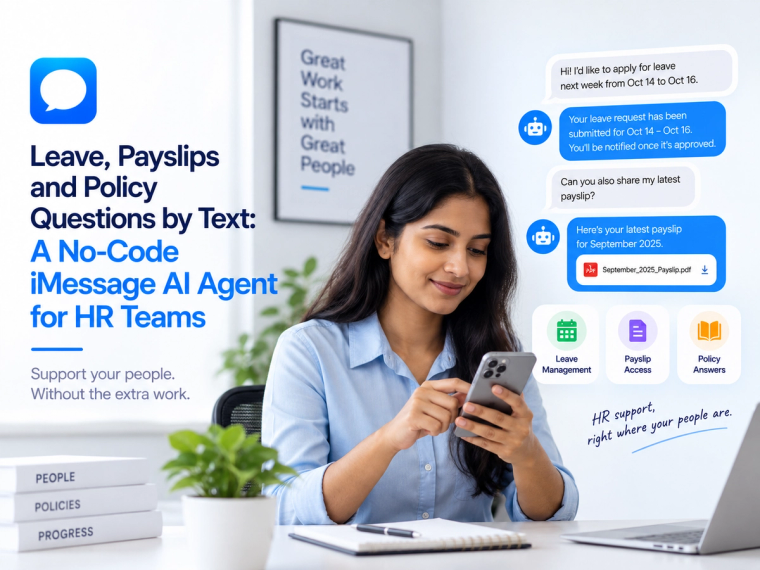
See how a no-code iMessage AI agent can answer leave, payslip, policy and onboarding questions using live HR data, approved knowledge and clear access controls.
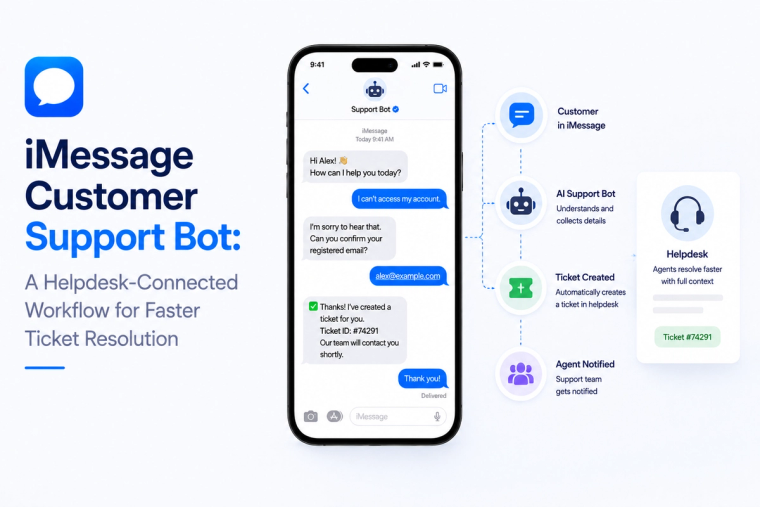
Design an iMessage customer support bot that reads helpdesk data, creates tickets, handles status questions and escalates complex cases with full conversation context.
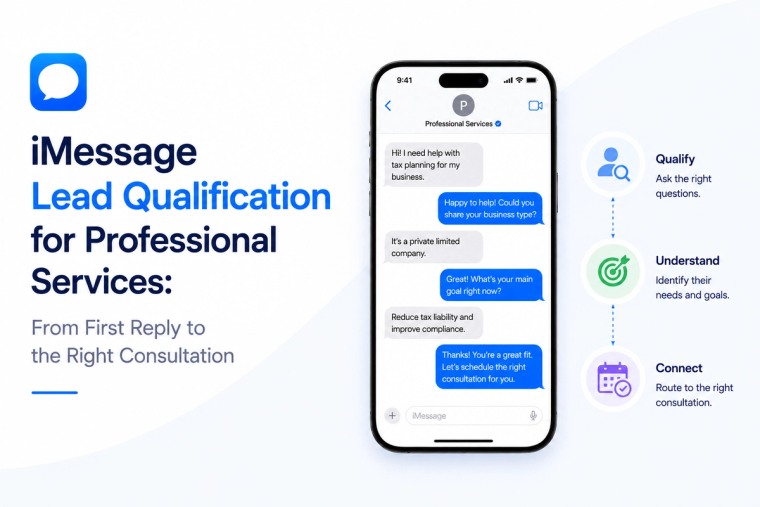
Build an iMessage lead qualification workflow for professional services that captures intent, routes prospects, updates the CRM and books the right next step.