Leave, Payslips and Policy Questions by Text: A No-Code iMessage AI Agent for HR Teams
See how a no-code iMessage AI agent can answer leave, payslip, policy and onboarding questions using live HR data, approved knowledge and clear access controls.

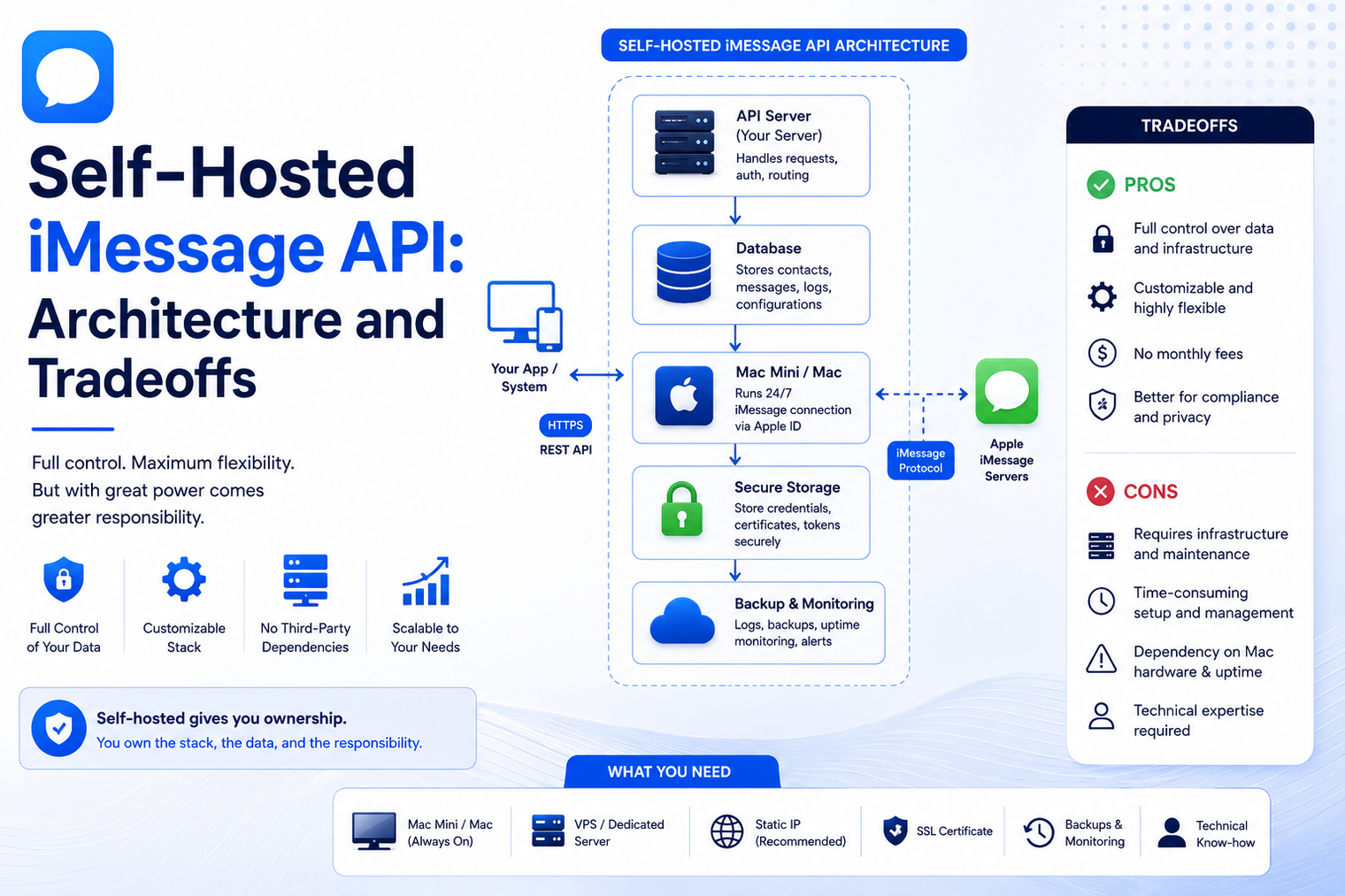
• Self-hosted describes an operating boundary, not a guarantee that every responsibility stays with one party.
• BYOC, private managed cloud and on-premises deployment provide different levels of control and operational burden.
• Data residency must cover logs, backups, support access, telemetry and disaster recovery, not only the primary database.
• Customer-managed keys and private networking improve control only when identity, rotation, monitoring and recovery are designed correctly.
• A successful enterprise deployment depends on a written shared-responsibility model for security, uptime, updates and incident handling.
For an enterprise team, the question is rarely limited to whether an application can send and receive iMessages. The harder questions concern control. Where do message contents, logs and credentials live? Who manages encryption keys? Can traffic stay inside a private network? What happens during an outage, a security review or a regulatory audit?
A self-hosted iMessage API addresses these concerns by placing some or all of the messaging stack inside infrastructure controlled by the customer. That may mean a deployment in the company’s cloud account, a private VPC, an on-premises environment or an air-gapped network. The model can improve control, but it also changes who is responsible for availability, upgrades, monitoring and incident response.
MessageBlue offers private and self-hosted enterprise deployment options for organizations that need the messaging layer to operate within defined infrastructure and data boundaries. This guide explains the architecture and the decisions an enterprise team should make before choosing that model.
A self-hosted iMessage API is a programmable messaging stack deployed in infrastructure that the customer controls. Applications call an API to send messages and receive events through webhooks or internal event systems, but the runtime, data plane or both operate inside the customer’s cloud account, private network or datacenter.
The term is often used too broadly. A dedicated instance managed by the vendor is private, but it is not the same as software running inside the customer’s account. A BYOC deployment places the stack in the customer’s cloud. An on-premises deployment runs within the organization’s own local infrastructure. An air-gapped deployment adds the requirement that the environment has no unrestricted public network path.
The correct choice depends on the organization’s threat model, regulatory obligations, data classification, operating maturity and tolerance for vendor access. The most restrictive option is not automatically the safest if the customer cannot patch, monitor or recover the system reliably.
Four enterprise deployment models
| Model | Where it runs | Main advantage | Main responsibility |
|---|---|---|---|
| Shared managed cloud | Vendor-operated shared platform with logical separation. | Fastest deployment and lowest customer operations burden. | Vendor controls most runtime operations; customer controls use and integration. |
| Private managed instance | Dedicated vendor-operated environment. | Greater isolation with managed operations. | Vendor runs the stack; both parties define access, support and data handling. |
| BYOC or customer VPC | Customer AWS, GCP or Azure account and network. | Customer owns the cloud boundary, network policy and data plane. | Customer and vendor share deployment, monitoring, upgrades and incident tasks. |
| On-premises or air-gapped | Customer datacenter or restricted private environment. | Maximum local control and data-sovereignty flexibility. | Customer carries substantial infrastructure, availability and lifecycle responsibility. |
The exact components vary by vendor and deployment, but an enterprise architecture should separate the control plane, data plane and customer application responsibilities. The goal is to prevent one technical component from becoming an undefined trust boundary.
Applications need a controlled endpoint for outbound message requests and administrative actions. Network policy should define whether the endpoint is private, internet-facing through protection layers or reachable through peering and private links.
Scoped service credentials should limit which applications, teams and numbers can perform each action. Enterprise identity may also include SSO, SAML or SCIM for administrative users. Machine credentials and human access should be governed separately.
The runtime validates requests, places work on queues, coordinates message delivery and receives inbound conversation activity. Workers should be horizontally scalable where supported and isolated from administrative interfaces.
Inbound messages, delivery changes and other supported events must reach customer systems reliably. Queues, retry policies, replay controls and idempotency protect the workflow when an endpoint is unavailable or an event is delivered more than once.
The architecture may store configuration, message metadata, delivery state, audit records and temporary message contents. Each data category needs a purpose, retention period, access rule, backup policy and deletion process.
API credentials, signing secrets, certificates and encryption keys should be stored in approved secret-management and KMS systems. Rotation and recovery procedures are as important as key ownership.
Metrics, logs, traces, alerts and dashboards should show message health, queue depth, webhook failures, resource saturation and administrative changes. Monitoring data must follow the same residency and access rules as production data.
The organization needs a controlled way to receive security patches and versioned releases. The deployment should define who tests an update, who approves it, how rollback works and what support information may be shared with the vendor.
The customer application still needs a reliable two-way iMessage API integration with authenticated requests, retry-safe event handling and clear ownership of conversation logic. Private infrastructure does not remove the need for sound application design.
The organization can decide which region, network and storage systems process message data. This can support internal policies that prohibit sensitive communications from entering a shared vendor environment. It can also simplify architecture reviews because the data plane sits within systems already covered by enterprise controls.
Bring-your-own-key designs allow the customer to manage key creation, rotation, access and revocation. This can reduce dependence on vendor-managed secrets, but only when the organization can recover from lost or disabled keys and monitor every use of them.
A deployment inside a VPC can use security groups, private subnets, routing policy, peering and approved egress controls. Administrative access can be tied to the company’s identity provider and privileged-access process rather than a separate vendor account model.
Enterprise teams may need shorter or longer retention based on the data category and legal purpose. A private deployment can support organization-specific retention windows, audit trails and evidence collection, provided those controls are implemented consistently across primary storage, logs and backups.
Some organizations cannot accept automatic production updates. Self-hosting allows releases to move through internal testing and approval. The tradeoff is that delayed updates can leave security fixes unapplied, so release governance needs target timelines and an exception process.
A customer-controlled environment requires people who understand networking, identity, compute, storage, backups, monitoring and incident response. Even when the vendor supplies infrastructure-as-code, the customer must operate the surrounding cloud or datacenter services.
The vendor may support the application stack, while the customer owns the cluster, database, network, KMS or load balancer. During an outage, both teams need fast access to the same facts. A vague support boundary can extend recovery time because each side waits for the other to diagnose the problem.
Versioned updates are safer than uncontrolled change, but they create testing and rollback work. The organization should know how long a version is supported, whether schema migrations are reversible and what happens when a critical security patch cannot wait for a normal release window.
A shared service may absorb routine growth. A private deployment needs explicit capacity planning, scaling rules and cost ownership. The team should test peak traffic, queue buildup, webhook failure and dependency degradation instead of assuming normal traffic represents production risk.
A private network cannot prevent an authorized application from sending an incorrect message or an AI agent from producing an unapproved response. Content policy, consent, authorization, human escalation and business-rule testing remain necessary.
Before procurement is complete, both parties should agree on a responsibility matrix. The contract, architecture document and operational runbook should tell the same story.
| Area | Customer responsibility | Vendor responsibility |
|---|---|---|
| Cloud or datacenter | Account, network, base platform, approved regions and physical controls. | Deployment requirements and supported topology. |
| Application stack | Configuration approval, integration and environment-specific controls. | Supported software, release artifacts, documentation and defect resolution. |
| Identity and access | User lifecycle, privileged access, service accounts and periodic review. | Product roles, authentication capabilities and access logging. |
| Keys and secrets | KMS ownership, policies, rotation, backup and emergency recovery. | Integration with supported key systems and secret-use documentation. |
| Monitoring | Infrastructure telemetry, alert routing and on-call response. | Application health signals, diagnostic guidance and product support. |
| Patching | Change windows, testing, approval and timely deployment. | Versioned fixes, advisories, compatibility notes and support policy. |
| Incidents | Internal coordination, containment decisions and regulatory process. | Product investigation, remediation guidance and agreed notification duties. |
| Data lifecycle | Business purpose, retention policy, legal hold and deletion approval. | Product controls that implement supported retention and deletion behavior. |
An iMessage API data residency review should map every place data can appear. Message content may be temporary, while metadata and audit logs remain longer. Support bundles, monitoring platforms, backups, object storage, crash reports and administrative exports can create additional copies.
• Which countries or regions process message contents, metadata and logs?
• Where are backups stored, and how quickly do deletion changes reach them?
• Can vendor support personnel access the environment, and through which audited process?
• Does telemetry leave the customer boundary, and can sensitive fields be removed?
• How are disaster-recovery replicas selected and tested?
• What happens to data when the service is terminated or migrated?
The published MessageBlue privacy information can support an initial review, but enterprise teams should validate the exact data flow and retention behavior for the proposed deployment model in their contract and architecture documentation.
HIPAA-ready or HIPAA-aligned describes an architecture and vendor arrangement that can support a covered workflow when it is configured and governed correctly. It does not mean that every message, integration or customer use is automatically compliant. The organization still needs an appropriate Business Associate Agreement where required, access controls, risk analysis, policies, training, minimum-necessary use and incident procedures.
Healthcare teams should also separate administrative messaging from clinical decision-making. Appointment scheduling, reminders and service coordination may fit an approved communication design. Medical advice, urgent care instructions and sensitive disclosures require additional clinical, legal and safety review.
• Policy requires message data to stay inside a customer-controlled cloud account or datacenter.
• The organization needs customer-managed keys, private networking or strict support-access controls.
• Regulatory or contractual requirements demand specific data residency, audit or retention behavior.
• The enterprise already has platform engineering, security operations and on-call capacity to run the environment.
• The business value of the messaging workflow justifies additional architecture, procurement and lifecycle work.
• The use case contains low-sensitivity data and does not require a customer-controlled data plane.
• The team needs to launch quickly and does not have infrastructure staff for a private deployment.
• A dedicated managed instance can meet isolation and contractual requirements without on-premises operations.
• The organization would struggle to apply patches, monitor dependencies or maintain high availability.
• The workflow is still experimental and the final scale or security classification is not known.
| Review area | What to verify |
|---|---|
| Architecture | Request current diagrams for control plane, data plane, network flows, dependencies and administrative access. |
| Deployment | Confirm supported cloud providers, regions, VPC patterns, on-premises requirements and air-gap limitations. |
| Data | Map message contents, metadata, logs, backups, telemetry, support exports and deletion behavior. |
| Security | Review encryption, key ownership, secret storage, identity, audit trails, vulnerability handling and penetration testing. |
| Operations | Define monitoring, capacity, backup, recovery, maintenance windows, support severity and escalation paths. |
| Updates | Confirm release cadence, support lifetime, patch timelines, rollback and compatibility responsibilities. |
| Compliance | Use exact approved wording for SOC 2, HIPAA-ready deployment, BAA availability and other certifications. |
| Commercial | Include infrastructure cost, implementation, support, upgrades and internal staffing in the total cost of ownership. |
MessageBlue positions its enterprise offering around private managed infrastructure, deployment in a customer cloud or VPC, and on-premises or air-gapped environments. The enterprise page also describes customer-managed KMS keys, identity controls, configurable audit and retention features, and support for organizations in finance, healthcare and government.
The correct deployment should be selected through architecture and risk review rather than by choosing the most restrictive label. A private managed instance may be enough for one organization. Another may require the data plane, logs and keys inside its own account. A third may need an on-premises design because the network cannot rely on normal cloud connectivity.
To scope the boundary, support model and operational responsibilities for your environment, talk to MessageBlue about an enterprise iMessage API deployment before finalizing the application architecture.
No. A private managed instance is dedicated to one customer but remains operated in a vendor-controlled environment. Self-hosting usually means the stack runs in infrastructure controlled by the customer, such as its cloud account, VPC or datacenter.
BYOC means bring your own cloud. The vendor supplies the supported application stack and deployment method, while the runtime operates in the customer’s AWS, GCP or Azure account. Responsibilities for updates, monitoring and support must be documented.
Not by itself. The organization must also verify backups, telemetry, support access, disaster recovery, logs and any external dependencies. Residency is a complete data-flow property, not only a database location.
MessageBlue presents on-premises and air-gapped options for enterprise use. The exact connectivity, update and support requirements should be validated during architecture review because messaging delivery may still depend on approved external paths or controlled transfer processes.
Responsibility is shared. The vendor may support the application stack, while the customer owns the cloud account, network, compute, storage and operational response. The service level and support boundary should state who detects, diagnoses and resolves each class of failure.
No. Private infrastructure can support a HIPAA-aligned design, but compliance depends on contracts, configuration, policies, access controls, risk management and the way the organization uses the system.
Connect any LLM to a real blue-bubble number and go live in minutes.
Deploy an Agent
See how a no-code iMessage AI agent can answer leave, payslip, policy and onboarding questions using live HR data, approved knowledge and clear access controls.
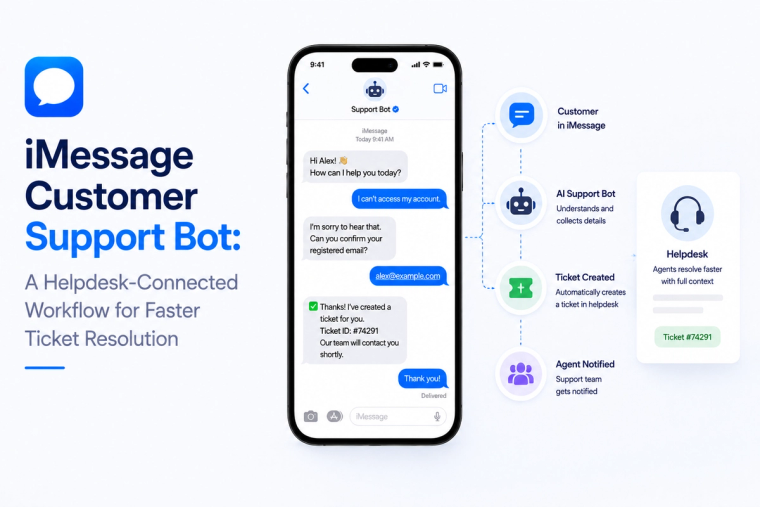
Design an iMessage customer support bot that reads helpdesk data, creates tickets, handles status questions and escalates complex cases with full conversation context.
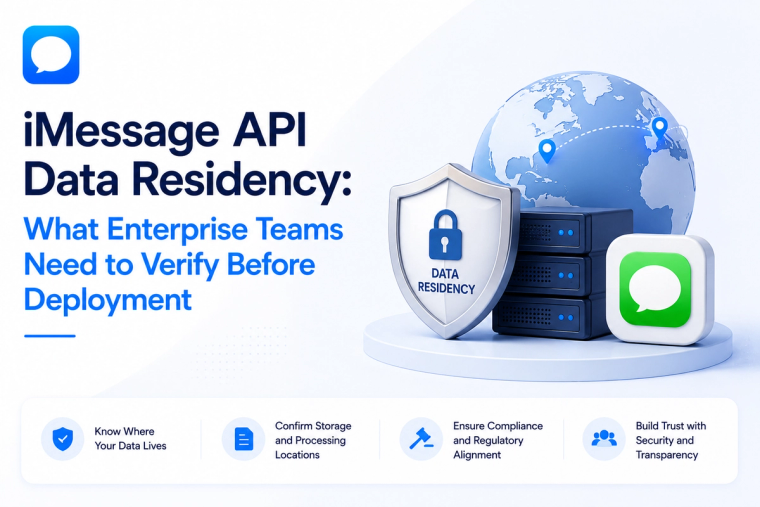
Evaluate iMessage API data residency across message content, logs, backups, keys, model providers, integrations and deployment boundaries before enterprise rollout.