Leave, Payslips and Policy Questions by Text: A No-Code iMessage AI Agent for HR Teams
See how a no-code iMessage AI agent can answer leave, payslip, policy and onboarding questions using live HR data, approved knowledge and clear access controls.
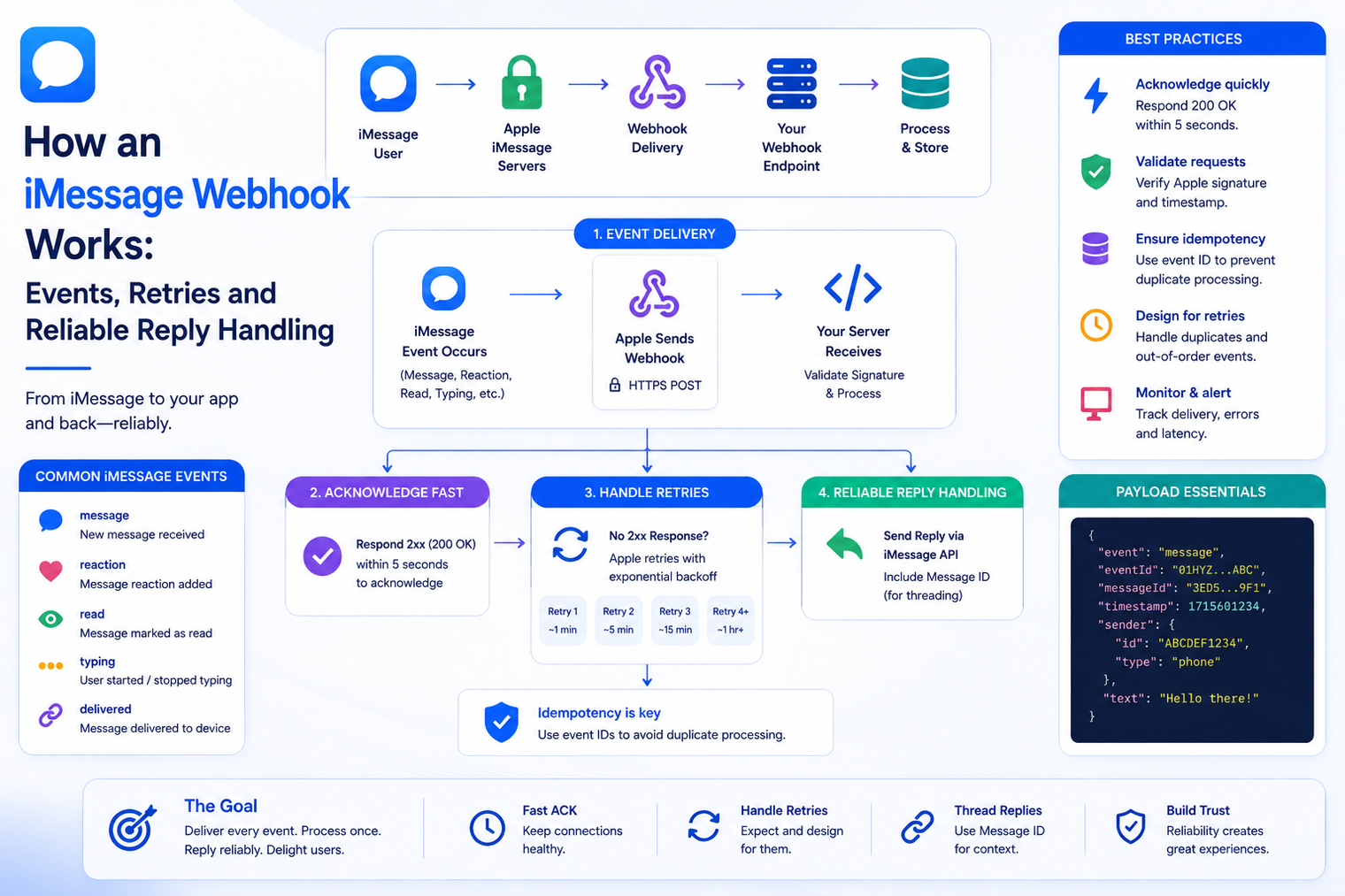
· An iMessage webhook delivers conversation activity to your server after the original API request.
· The receiving endpoint should authenticate the event, store it and acknowledge it quickly before doing slow work.
· Retries improve reliability, but they require event-level deduplication and idempotent business actions.
· Delivery updates, inbound messages and reactions should update one shared conversation state model.
· Monitoring should expose missing events, repeated failures, queue delay and customer-impacting processing errors.
Reliable Reply Handling
Sending a message is only half of a messaging integration. The customer can reply, react, read the message or trigger a fallback outcome after the original API request has already returned. A webhook is the mechanism that carries those later events back to the application.
A reliable integration treats each webhook as part of a distributed event system. It verifies the sender, stores the event, prevents duplicate actions, updates conversation state and routes the work to the correct service. MessageBlue documents this event-driven model as part of its two-way iMessage API for developers.
An iMessage webhook is an HTTPS request sent by the messaging platform to an endpoint controlled by your application. Instead of repeatedly asking the provider whether anything changed, your system receives an event when supported conversation activity occurs.
The event can contain an inbound customer message, a reaction or a delivery-state change. The application then decides what the event means. A support reply may open a ticket. A confirmation may update an appointment. A free-form question may enter an AI workflow. A failed delivery may activate another channel policy.
Webhooks are asynchronous. The outbound send request and the later event do not happen in one transaction. Your system must therefore maintain identifiers and state that connect the original message, the receiving number, the customer and every later event.
The current MessageBlue API reference lists three webhook event families: inbound messages, inbound reactions and message status updates. The documentation uses event values such as inbound_message and inbound_reaction, while status callbacks report delivery progress.
| Event family | Typical payload purpose | Common application action |
|---|---|---|
| Inbound message | Carries customer text, participants, sender and receiving-line context. | Attach the message to a conversation and route it to rules, AI or a person. |
| Inbound reaction | Reports a supported reaction to an existing message. | Record engagement or use the reaction as a lightweight confirmation when appropriate. |
| Status update | Reports progress such as sent, delivered, read, failed or fallback. | Update message state, trigger recovery policy and expose the result to operations. |
The provider documentation may evolve, so production code should tolerate new fields and unknown event values without failing the entire endpoint. Parse the fields you need, preserve the original event safely and keep schema assumptions explicit.
A customer sends a message, adds a reaction or a delivery state changes after an outbound request.
The messaging layer assigns an event identifier and prepares the supported payload.
Authentication data is attached so the receiving application can verify the event source and freshness.
The application captures the unmodified body and the required headers before parsing.
The signature, timestamp and event identifier are checked, then the event is written to durable storage.
A background process deduplicates the event, loads conversation state and performs the required action.
Message state, workflow state, retries, errors and any customer-visible reply are linked for monitoring and audit.
A webhook URL is public by necessity. Anyone who discovers it can send an HTTP request, so the endpoint must verify that the event came from the provider. Do not begin business processing before authentication succeeds.
The current MessageBlue API reference describes signed webhook requests with an event ID, timestamp and HMAC signature. It instructs developers to verify the signature against the raw request body. Re-serializing parsed JSON can change whitespace or field ordering and produce a different hash, so verification should happen before transformation.
· Read and preserve the raw request bytes.
· Confirm the signature with the current signing secret and documented algorithm.
· Check the timestamp against an acceptable age window to reduce replay risk.
· Use the event identifier as the primary deduplication key.
· Reject malformed or unauthenticated events without exposing secret details in the response.
Secret rotation also needs a plan. During a controlled transition, the endpoint may temporarily accept signatures from the old and new secret, then retire the previous value after all destinations have been updated.
The receiving endpoint should do as little work as possible before returning a successful response. Signature verification, minimal validation and durable event storage belong in the request path. Model calls, CRM updates, file downloads and customer replies belong in a background worker.
This separation protects both systems. The provider receives a timely acknowledgment, while your application can retry slow business operations without asking the provider to redeliver the same event. It also prevents a temporary dependency failure from turning into a webhook timeout storm.
| Request path | Background worker |
|---|---|
| Capture raw body and headers | Load customer and conversation context |
| Verify signature and timestamp | Run rules, AI or workflow logic |
| Validate required identifiers | Call CRM, scheduling or support systems |
| Store event and deduplication key | Send a response when appropriate |
| Return success quickly | Record completion, failure and retry state |
A retry means the provider did not receive a successful acknowledgment or intentionally replayed an event. It does not necessarily mean your first processing attempt failed. The endpoint may have completed the business action and lost the response, or it may have stored the event before a network interruption.
For that reason, webhook processing must be idempotent. Reprocessing the same event should not create a second support ticket, book another appointment, send a duplicate reply or advance the CRM stage twice.
1. Create a unique record keyed by the provider event identifier.
2. Insert the event atomically, or detect that the identifier already exists.
3. Acknowledge a known duplicate without repeating the business action.
4. Use separate idempotency keys for downstream actions that may retry independently.
5. Record the final outcome so operators can distinguish duplicate delivery from repeated failure.
The current MessageBlue product pages also describe automatic webhook retries and replay. Those features are valuable only when the receiving system is designed to handle repeated delivery safely.
Distributed systems can deliver events later than expected or through different paths. A read update may appear close to a delivery update. A customer reply may arrive while an outbound status is still being processed. A replayed event can be older than the state already stored.
Model message state as a controlled transition rather than replacing the current value with every incoming payload. Compare timestamps, maintain event history and define which transitions are valid. A late “sent” event should not move a message backward after it has already been marked delivered or read.
Conversation state also needs separate fields. Message delivery, workflow ownership, human handoff and AI processing are related, but they are not the same status. Keeping them separate makes failures easier to diagnose.
A phone number alone is rarely enough to identify the correct workflow. The customer may have several open orders, appointments or sales opportunities. The webhook handler should use the receiving line, participant set, conversation identifiers and your own stored history to choose the correct context.
A practical routing sequence is: identify the business line, locate the active conversation, load the related record, check whether a person owns the thread and then select rules, AI or human handling. If context is ambiguous, ask a focused question instead of guessing.
Teams can route the same inbound event into an application that can build an AI agent for iMessage, but the messaging webhook should remain separate from model reasoning. The event layer handles authentication and delivery. The agent layer handles interpretation, knowledge, tools and response policy.
When a business uses a shared or existing number, the webhook processor must respect conversation ownership. A customer may reply while a representative is already handling the thread from a phone. Without coordination, the automated system can send a conflicting response.
A programmable iMessage number should therefore include human-activity locks, sequence-stop rules, ownership timestamps and a clear handoff state. The inbound webhook is often the signal that stops an outbound sequence and alerts the assigned person.
Delivery events are operational inputs. A sent state confirms progress, while delivered, read, failed or fallback outcomes can determine what the application does next. The exact behavior should be based on current provider documentation and the business workflow.
A failed message may trigger a review, a corrected number request or an approved alternate channel. A fallback result should be recorded so the team knows which customer experience actually occurred. A read state can inform reporting, but it should not automatically generate aggressive follow-up.
Store the original channel request, the final channel result and the latest supported message state. That history prevents misleading dashboards and helps support teams explain what happened.
A webhook integration can appear healthy while silently delaying customer replies. Monitor the event pipeline from receipt through business completion, not only the HTTP success rate.
| Signal | Why it matters |
|---|---|
| Authentication failures | A sudden increase can indicate secret mismatch, replay attempts or implementation errors. |
| Acknowledgment latency | Slow responses can cause redelivery and duplicate pressure. |
| Queue age | Shows whether customers are waiting even when the webhook endpoint is healthy. |
| Duplicate event rate | Helps distinguish normal retries from unstable acknowledgments. |
| Processing failure rate | Reveals errors in AI, CRM, scheduling or internal services. |
| Reply completion time | Measures the customer-visible delay from inbound message to useful response. |
| Dead-letter volume | Identifies events that exhausted application retries and need intervention. |
Logs should contain correlation identifiers, event type, timestamps and outcome without exposing more message content than operations genuinely need. Sensitive environments may require additional control over retention, access and data location.
Webhook security is only one part of the architecture. Regulated teams may also need private ingress, restricted egress, customer-managed keys, identity controls, audit logs and a documented retention policy. They should map where the raw event, message content, queue payload, logs, backups and support telemetry travel.
MessageBlue publishes private iMessage API options that include customer-cloud, VPC and on-premises deployment paths. Security teams should still validate the exact boundaries, responsibilities and controls for the selected arrangement before production use.
| Test | Expected behavior |
|---|---|
| Invalid signature | Reject the event and record a safe security log. |
| Old timestamp | Reject or quarantine according to the replay policy. |
| Duplicate event ID | Acknowledge without repeating completed actions. |
| Endpoint returns an error | Provider retry and application observability should make the failure visible. |
| Worker dependency is unavailable | Keep the event queued and retry the business job without losing it. |
| Events arrive out of order | Preserve valid state and avoid moving message status backward. |
| Unknown event type | Store safely, avoid destructive processing and alert for schema review. |
| Human owns the conversation | Pause automation and notify the correct representative. |
| AI call times out | Use a controlled apology, retry policy or human handoff instead of silence. |
· Webhook destinations use HTTPS and are protected by documented signature verification.
· Raw request bytes are available for verification before JSON transformation.
· Event identifiers are stored in a durable, unique index.
· The endpoint acknowledges quickly after safe storage.
· Background work has bounded retries and a dead-letter path.
· State transitions handle late and repeated events.
· Inbound routing includes conversation and ownership context.
· Customer-visible replies are protected from duplication.
· Dashboards show queue delay, failures and end-to-end response time.
· Runbooks explain secret rotation, replay, outage recovery and manual intervention.
MessageBlue provides the transport and event layer between an iMessage-enabled number and the customer application. Its current API reference documents signed webhook delivery for inbound messages, reactions and status updates, along with identifiers that can support deduplication. The application remains responsible for business state, downstream retries, workflow ownership and safe customer responses.
Teams comparing providers should test this behavior under failure, not only during a successful demo. The current best iMessage API for business guide can help create a wider shortlist, but a production decision should include endpoint failure, replay, duplicate delivery and observability tests.
A durable webhook pipeline turns iMessage activity into reliable application behavior. Verify the event, store it before slow work, deduplicate retries, preserve valid state and make failures visible. When those foundations are correct, customer replies can safely trigger AI, CRM, support and operational workflows without disappearing or creating repeated actions.
Explore the MessageBlue API and test the full event lifecycle, including invalid signatures, endpoint downtime, duplicate delivery and human handoff.
A webhook delivers supported events when they occur, which reduces unnecessary requests and can shorten response time. The receiving system still needs monitoring and recovery logic.
After successful verification and durable storage, return the provider-required success response quickly. Follow the current API documentation for exact status and timing expectations.
Providers retry when acknowledgments fail or when an event is replayed. Network uncertainty can also make a completed first attempt look unsuccessful to the sender.
Deduplicate by event ID, use idempotency keys for outbound actions and store the relationship between the event, workflow action and customer-visible message.
Usually not. Store and acknowledge the event, then call the model from a worker. This keeps the endpoint fast and makes model failures easier to retry safely.
Record it safely, avoid destructive actions and alert the engineering team. Forward-compatible handling prevents a new provider field from breaking all webhook delivery.
No. Use signatures with timestamp checks, secret management, access control, safe logging, dependency security, retention rules and appropriate network architecture.
Connect any LLM to a real blue-bubble number and go live in minutes.
Deploy an Agent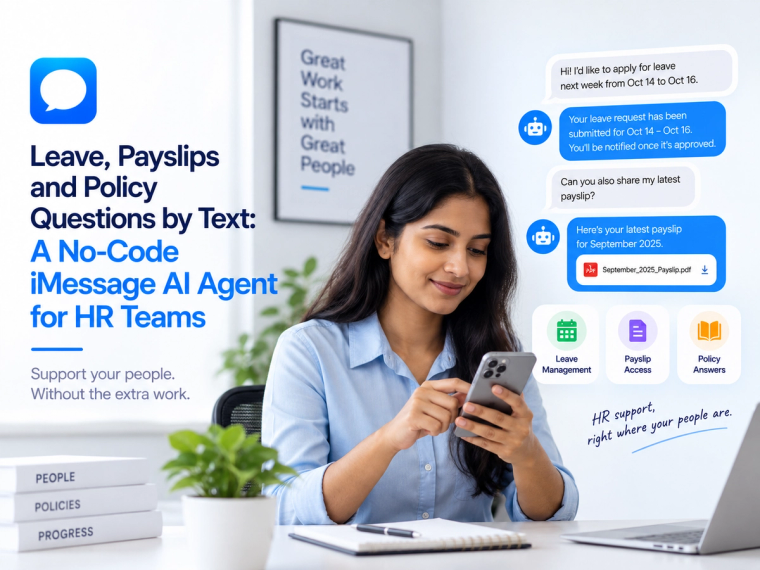
See how a no-code iMessage AI agent can answer leave, payslip, policy and onboarding questions using live HR data, approved knowledge and clear access controls.
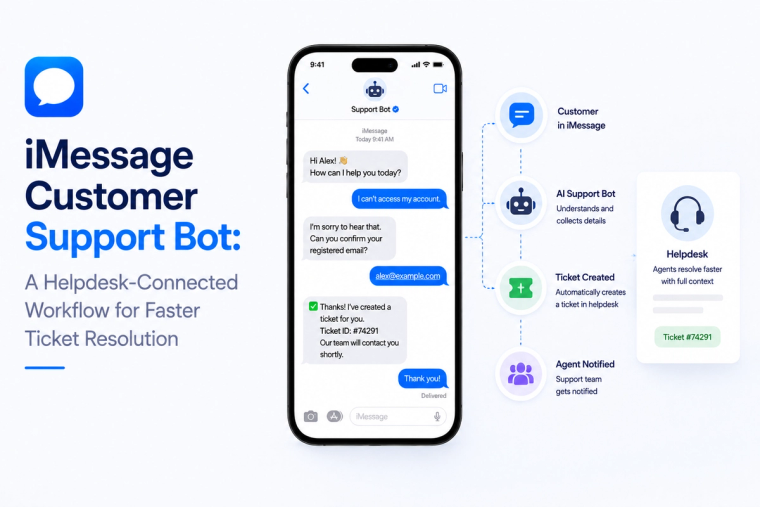
Design an iMessage customer support bot that reads helpdesk data, creates tickets, handles status questions and escalates complex cases with full conversation context.
Evaluate iMessage API data residency across message content, logs, backups, keys, model providers, integrations and deployment boundaries before enterprise rollout.