Leave, Payslips and Policy Questions by Text: A No-Code iMessage AI Agent for HR Teams
See how a no-code iMessage AI agent can answer leave, payslip, policy and onboarding questions using live HR data, approved knowledge and clear access controls.

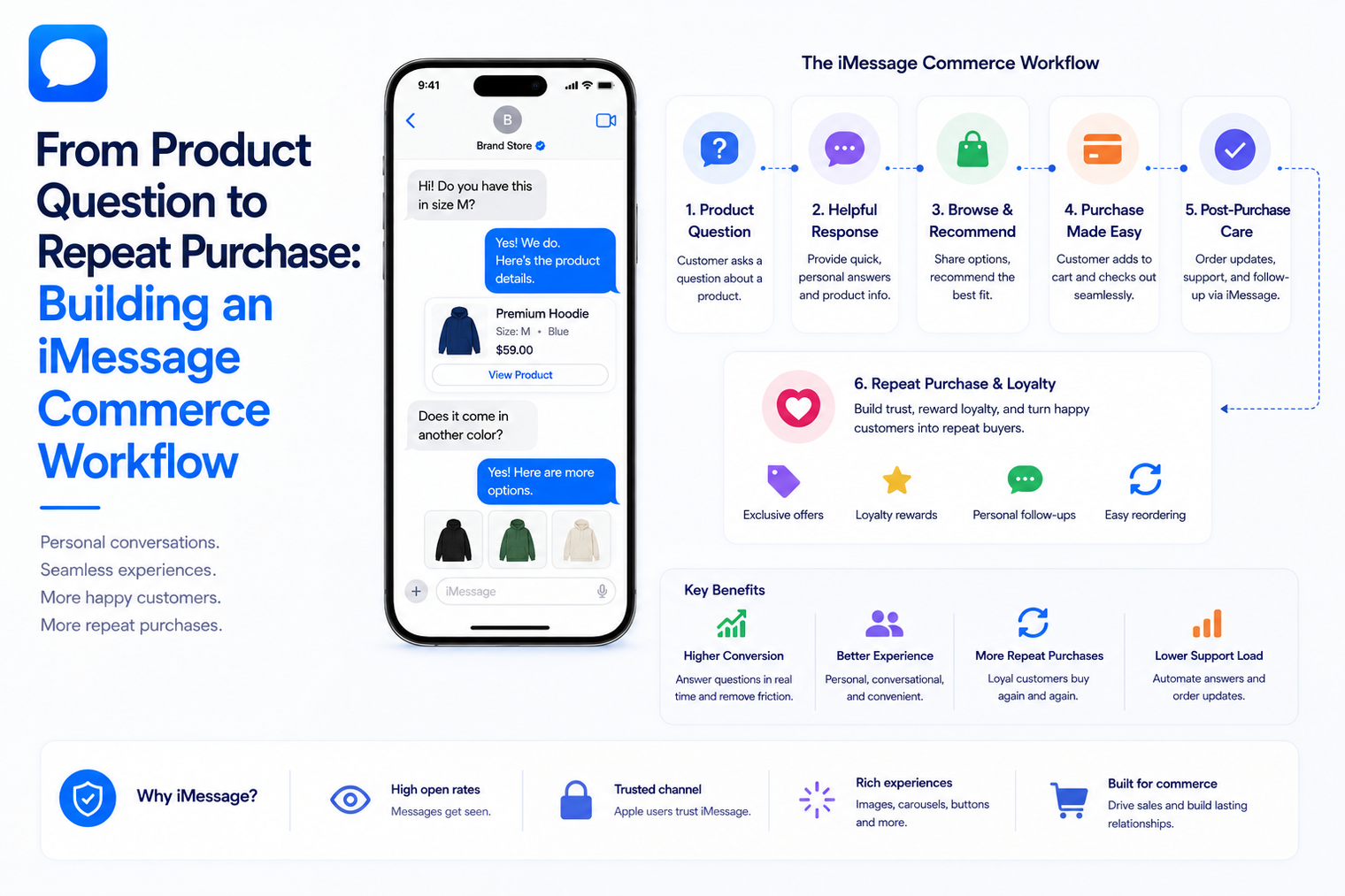
· The strongest commerce use cases are two-way: product questions, order lookup, returns, exchanges and replenishment all benefit from a reply path.
· Live catalogue, order, inventory and policy data should drive the answer. The AI model should not guess current stock, shipping status or return eligibility.
· A good workflow identifies the shopper with the least friction possible, but still verifies identity before exposing sensitive order details or making account changes.
· Human escalation is part of the design, especially for damaged goods, payment disputes, fraud concerns and unusual fulfillment problems.
· Measure resolved conversations and completed customer actions, not message volume alone.
E-commerce conversations are rarely one-and-done. A shopper asks whether an item will fit, places an order, checks delivery, requests an exchange and may buy again weeks later. The problem is that each stage often lives in a different place: product pages, email, tracking portals, support tickets and marketing flows. A messaging workflow can bring those moments into one thread without forcing the customer to start over every time.
An iMessage commerce workflow should do more than send notifications. It should recognize the customer, read current store data, answer only what it can verify, trigger the right action and hand off exceptions cleanly. That turns business iMessage automation into an operational layer for shopping, support and repeat purchase rather than another outbound campaign channel.
This guide focuses on the workflow design behind product questions, order updates, returns and reorders. It also explains where AI helps, where live commerce systems must remain the source of truth and how MessageBlue can provide the messaging layer while your store, support stack and business rules continue to control the facts.
A customer can move from curiosity to support in a few minutes. The systems behind that journey usually do not move with them. Product discovery may happen on a storefront, shipping status lives with a carrier, returns are handled in a portal, and customer support sits in a helpdesk. The shopper experiences one purchase, but the business sees several disconnected records.
That fragmentation creates repetitive questions. A shopper who already shared a size concern may have to explain it again during an exchange. A customer asking where an order is may be sent to a tracking page, then back to support when the tracking looks wrong. The friction is not caused by a lack of data. It is caused by the customer having to find the right system each time.
A persistent messaging thread can become the front door to those systems. The thread itself does not replace the commerce platform, fulfillment provider or helpdesk. It gives the customer one conversational interface while the workflow reads and writes to the systems that already hold the truth.
A useful commerce workflow maps each customer message to a business action. The agent needs to understand intent, identify the relevant record, fetch current data, apply policy and decide whether to answer, act or escalate.
| Customer intent | Source of truth | Automated action | Escalate when |
|---|---|---|---|
| Product question | Catalogue, product data, approved FAQs | Answer sizing, compatibility, material, availability or policy questions from current data | The answer is subjective, high-risk or missing from approved data |
| Order status | Order management and shipping data | Find the order, summarize current status and provide the next useful step | Tracking conflicts, delivery is unusually late or identity is uncertain |
| Return or exchange | Order record and return policy | Check eligibility, collect reason and start the supported return or exchange workflow | Item is damaged, outside policy, disputed or high value |
| Reorder | Purchase history and current catalogue | Confirm the item, quantity, current availability and next purchase step | Price, formulation, compatibility or account status changed |
| General support | Knowledge base and support system | Answer routine questions and create or update a support case when needed | Customer requests a person or the issue requires judgment |
Many product questions are not really requests for more information. They are requests for enough confidence to buy. A shopper wants to know whether a part is compatible, whether a jacket runs small, whether a material can tolerate a certain use, or whether an item is available in another color.
The workflow should answer from structured product data and approved guidance. If the question requires an opinion, the agent can ask a narrowing question rather than inventing certainty. For example, instead of saying a shoe will definitely fit, it can explain the published fit guidance and ask what size the customer normally wears.
This is where an iMessage AI agent can add value. The model interprets the shopper's wording and keeps the conversation natural, while the catalogue, policy and product systems provide the facts that the response is allowed to use.
"Where is my order?" looks simple, but a useful answer often needs several pieces of context: which order the customer means, whether it has shipped, the latest carrier event, whether the promised date has passed and what the customer should do next. A generic shipping notification cannot handle the follow-up question that comes after it.
An iMessage order updates API can support the transport and event layer for this experience. Your application still decides how to match the customer to an order, which data may be exposed, how to interpret fulfillment states and when a human needs to step in.
The best response is brief and action-oriented. If the parcel is out for delivery, say that and offer the tracking link. If it is delayed, explain the latest verified state and the escalation path. If the system cannot confidently identify the order, ask for one additional piece of information rather than searching broadly across customer records.
Returns combine conversation with business rules. The customer describes what happened in natural language, but eligibility depends on structured facts such as purchase date, item category, condition, seller, payment method and the current return policy.
Use the AI layer to understand intent and collect the reason. Use deterministic business logic to decide whether the item is eligible. If an exchange is supported, the workflow can verify the requested replacement against current inventory before confirming anything.
Do not let the model improvise exceptions to policy. When the order falls outside normal rules, the correct response is an escalation with the conversation context attached. That makes the human review faster without pretending that every edge case can be automated.
A repeat purchase is different from a cold promotion because the business has context. The customer may have bought a consumable, replacement part or recurring product before. That history can make a message genuinely useful, but only when timing and relevance are controlled.
A reorder workflow should confirm that the product is still available, the variant is still correct and the customer wants to continue. If the price or product changed, disclose the change before asking for a purchase decision. Do not assume that a previous purchase is blanket permission for unrelated marketing.
The conversation can also work inbound-first. A customer texts, "same coffee as last time," and the agent looks up the prior item, confirms the current option and presents the next step. That is a better use of conversational automation than sending frequent generic reminders.
Commerce data changes constantly. Inventory moves, orders are rerouted, promotions expire, policies change and products are replaced. A model that once read a policy document cannot be trusted to know the current state of an individual order or SKU.
Separate stable knowledge from live data. Stable knowledge includes tone, general FAQs, shipping regions and explanation of policies. Live data includes order status, stock, current price, account details and return eligibility. The response should combine both, but the live facts should be fetched at the moment they are needed.
Teams that want to start with configuration rather than custom orchestration can use a no-code iMessage AI agent for suitable workflows, then add developer logic when they need more complex identity checks, custom policy engines or proprietary commerce systems.
The phone number that starts the conversation is useful context, but it should not automatically authorize every action. The workflow needs a simple permissions model based on the sensitivity of the request.
· Low sensitivity: general product questions and public policy information can usually be answered without account verification.
· Medium sensitivity: order status may require a match to the sender plus an additional verification step when the record contains personal details.
· High sensitivity: address changes, payment actions, refunds, account changes and unusual return exceptions should use stronger verification and explicit confirmation.
· Internal users: staff access to store operations should be scoped to their role and connected account, not granted because they know the business number.
The safest implementation makes authorization decisions in application logic. The AI agent can explain what information is needed, but it should not decide that a user has permission based only on conversational confidence.
Automation earns trust when it knows when to stop. Damaged deliveries, suspected fraud, charge disputes, missing high-value packages and emotionally charged complaints often require human judgment. The customer should not need to repeat the entire story after escalation.
A good handoff package includes the customer's stated problem, the matched order, verified status, actions already attempted and the reason automation stopped. It should also pause automated sequences while the human owns the thread.
If the brand already has a recognized line, a programmable iMessage number can preserve that continuity. The same conversation can support automation when the request is routine and normal manual texting when a person needs to take over.
1. Choose one customer job first: Start with a high-volume, low-risk job such as order status or product FAQs. Avoid launching product discovery, returns, payments and loyalty all at once.
2. Map the systems involved: List the data sources that answer the question: catalogue, order management, shipping, inventory, policies, helpdesk and customer profile.
3. Define the customer identity rule: Decide when the sender number is enough, when additional verification is required and what the agent must never reveal without confirmation.
4. Write action boundaries: Document what the workflow may answer, what it may change, what requires confirmation and what always escalates.
5. Test messy conversations: Use partial order details, multiple recent orders, wrong phone numbers, out-of-stock exchanges, delayed parcels and contradictory customer claims.
6. Measure outcomes, then expand: Add new intents only after the first workflow resolves real conversations reliably and support teams trust the escalation path.
More conversations are not automatically better. Measure whether messaging reduces effort for the shopper and the business. Useful metrics include:
· Resolution rate for product, order and policy questions without human intervention.
· Average time from first question to a useful answer or completed action.
· Escalation rate by intent, which reveals where data or policy coverage is weak.
· Repeat-contact rate for the same issue, which shows whether the first answer actually solved the problem.
· Return or exchange completion rate after the customer starts the process in the thread.
· Reorder conversion from customer-initiated conversations and carefully targeted replenishment workflows.
· Support workload saved, paired with customer satisfaction and exception quality.
MessageBlue is the iMessage infrastructure layer, not the store of record for your products or orders. It can deliver two-way conversations, route inbound messages to an agent or application and connect the thread to supported business tools. Your commerce platform, helpdesk and application logic continue to own inventory, orders, policy and authorization.
That separation is useful. It lets a commerce team improve the customer interface without moving every operational system into a new platform. Start with one verified workflow, connect the data it needs and keep high-impact decisions deterministic.
The best commerce automation does not try to turn every purchase into a campaign. It removes small moments of effort: finding an order, checking a size, starting an exchange or buying the same item again. When live data, clear permissions and human escalation sit behind the thread, iMessage can become a practical customer interface instead of another notification channel.
Explore MessageBlue for e-commerce workflows, connect the systems that hold the truth and test one complete customer journey from question to resolution before expanding.
Yes, when the agent is grounded in approved product information or connected to a current catalogue. It should ask for clarification when the data does not support a confident answer.
Yes, a connected workflow can look up the relevant order and return the latest verified status in the conversation. Identity rules should match the sensitivity of the information being shown.
No. The model can understand the request and collect details, but eligibility should come from the current return policy and deterministic business rules.
Yes. The workflow should make human takeover explicit, transfer the relevant context and pause automation while a person owns the conversation.
Not always. A no-code path can work for straightforward knowledge and connected-tool workflows. Custom code becomes useful when the business needs proprietary systems, complex identity checks or custom transaction logic.
Order status is often a strong starting point because the intent is easy to recognize, the data already exists and the success condition is clear. Product FAQs can also work well when the catalogue data is reliable.
Connect any LLM to a real blue-bubble number and go live in minutes.
Deploy an Agent
See how a no-code iMessage AI agent can answer leave, payslip, policy and onboarding questions using live HR data, approved knowledge and clear access controls.
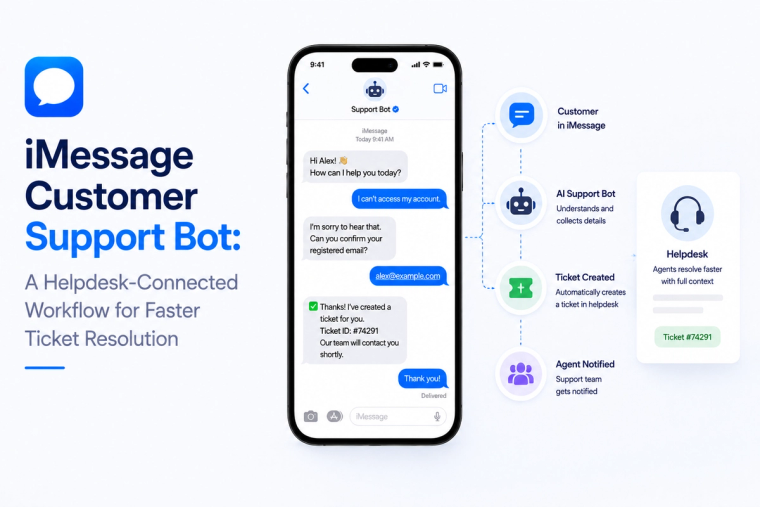
Design an iMessage customer support bot that reads helpdesk data, creates tickets, handles status questions and escalates complex cases with full conversation context.
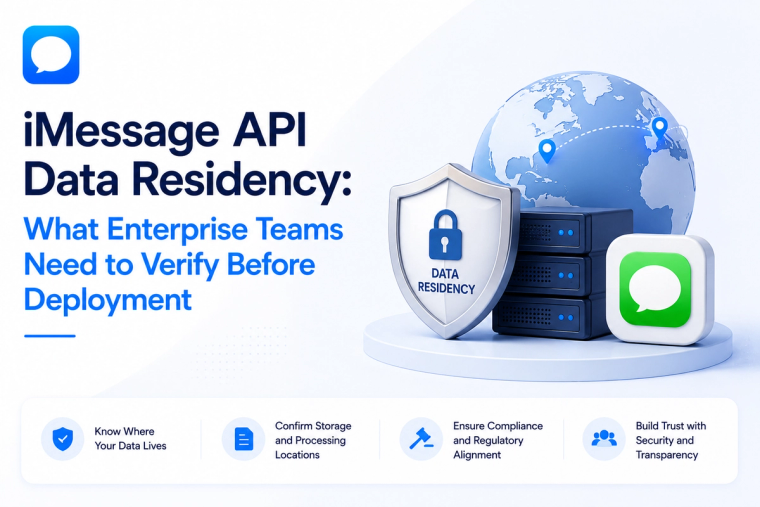
Evaluate iMessage API data residency across message content, logs, backups, keys, model providers, integrations and deployment boundaries before enterprise rollout.