From Text to Task: How an iMessage AI Agent Can Run Project Workflows
Learn how an iMessage AI agent can capture tasks, check project status, update issues and route work through Jira, Linear, ClickUp and other project systems.

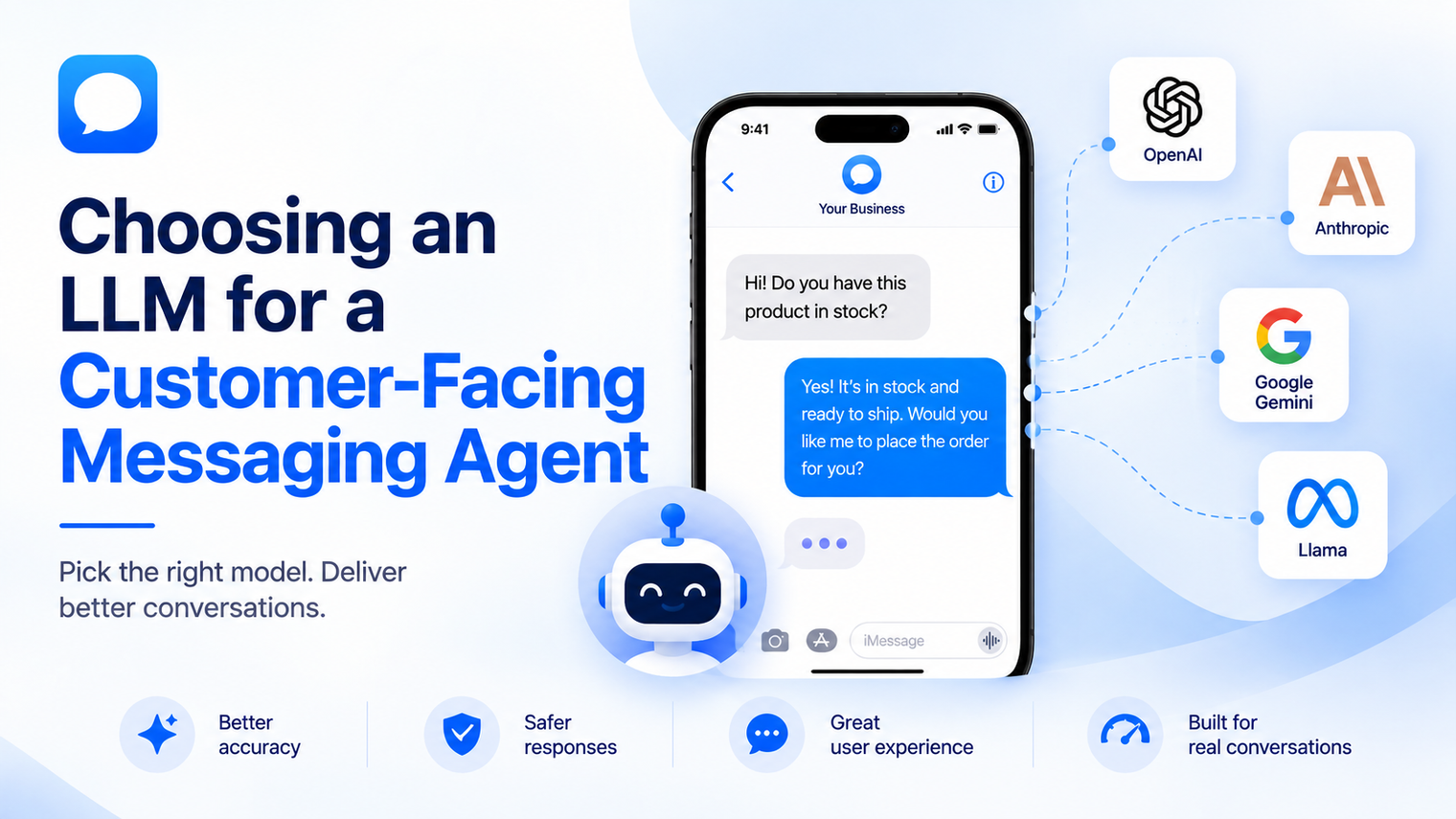
• Choose a model against real conversation tasks, not marketing claims or benchmark rankings alone.
• Evaluate quality, latency, cost, tool use, context handling, safety and human escalation as one system.
• A smaller model can be the better production choice when the workflow is narrow and the knowledge is well structured.
• Model flexibility reduces lock-in and lets teams route different tasks to different models over time.
• The messaging layer, knowledge layer and operational controls matter as much as the model itself.
The model behind a customer-facing messaging agent shapes every reply, but model choice is only one part of the product. A strong agent must understand the request, use the right business information, complete approved actions, respond at a natural pace and recognize when a person should take over. The best model is therefore not automatically the most powerful model on a public benchmark. It is the model that performs reliably inside your actual conversation workflow.
For teams building AI agents that live in iMessage, this decision is especially practical. Customers expect short, useful messages rather than long demonstrations of intelligence. They also expect the conversation to remember context, respect boundaries and move toward a clear outcome.
A website assistant can display a long answer, several cards and a full navigation menu. A messaging agent works inside a narrower interface. Each reply arrives as part of an ongoing thread, often while the customer is moving between other tasks. That changes what good performance looks like.
A useful messaging response is usually concise, specific and easy to act on. It should ask one focused follow-up question when information is missing. It should avoid repeating context the customer has already provided. It should also know when silence, confirmation or escalation is more helpful than another paragraph.
This means a model with excellent long-form writing may still perform poorly in a sales qualification, reservation or support workflow. The agent may sound polished but fail to capture a required field, call the correct tool or preserve the customer’s intent across several short messages.
Do not begin with a list of model providers. Begin with a task inventory. Write down the conversations the agent should handle, the actions it may take and the situations it must decline or escalate. This turns model selection from a vague technology debate into a product decision.
· Answer routine questions using approved business content.
· Qualify an inbound lead and collect required details in a natural order.
· Look up an order, appointment or account status through a connected tool.
· Book, reschedule or cancel within defined rules.
· Summarize the thread for a representative during human handoff.
· Refuse requests that fall outside the agent’s authority.
· Recognize urgency, frustration or ambiguity and route the conversation safely.
A model should be tested on the complete task, not only on its ability to generate a convincing sentence. For example, a reservation agent must interpret the request, identify the correct booking, check available times, make the change and confirm the result. A model that writes a friendly reply but skips the tool call has not completed the job.
Customer-facing agents operate within rules. The model may need to ask for an email address before booking, avoid discussing unpublished pricing or confirm a destructive action. Test whether it follows these instructions across varied wording, incomplete requests and multi-turn conversations. One successful prompt is not evidence of reliable behavior.
The ideal reply should feel helpful without becoming verbose. Evaluate whether the model answers the question first, uses plain language and keeps the next step obvious. Review tone consistency as well. A support agent, sales assistant and personal concierge should not all sound identical.
Many agents must do more than answer. They need to query a CRM, check a calendar, create a ticket or retrieve order data. The model should select the correct tool, supply valid arguments and handle tool errors without inventing a result. Structured output accuracy often matters more than creative writing quality.
Messaging threads can unfold over minutes, days or weeks. Test whether the model can distinguish the current request from earlier context and use durable customer preferences appropriately. Memory should be purposeful. Storing everything creates privacy risk and can introduce irrelevant details into later replies.
A customer notices delay in a live conversation. Measure the full response time from inbound message to delivered reply, including retrieval, model inference, tools and message transport. A slightly less capable model may create a better experience if it responds consistently within the expected conversational rhythm.
Estimate cost per resolved conversation rather than cost per token alone. Include retries, tool loops, retrieval context, summaries and escalations. A low-cost model that requires several repair prompts can be more expensive than a stronger model that completes the task correctly on the first attempt.
The model must respect business boundaries without becoming unhelpful. Test sensitive requests, policy exceptions, attempts to override instructions and situations where the customer needs a person. The goal is not maximum refusal. It is predictable behavior that protects the customer and the business while preserving a useful path forward.
A reliable evaluation set should look like real customer traffic. Include clean requests, vague questions, spelling errors, multiple intentions in one message, emotional language and conversations that change direction. Keep personally identifiable data out of the test set unless it has been properly anonymized and approved for use.
1. Collect representative conversation patterns from support, sales and operations teams.
2. Rewrite them as safe test scenarios with expected outcomes and required actions.
3. Create scoring criteria for factual accuracy, task completion, tone, brevity, tool use and escalation.
4. Run every candidate model on the same scenarios with the same system instructions and knowledge sources.
5. Review failures by category instead of relying only on an average score.
6. Retest after prompt, knowledge, tool or model changes.
A model that scores well overall may still fail a critical category. For a healthcare administrative workflow, one incorrect disclosure can matter more than dozens of good scheduling replies. Weight the evaluation according to business risk.
Smaller models are often effective when the agent has a narrow job, a clean knowledge base and a limited set of tools. They can offer faster responses and lower operating cost. They may also be easier to constrain because the workflow provides most of the structure.
A larger model becomes more valuable when conversations are ambiguous, the agent must reason across several systems or the language varies widely. Even then, routing can be more efficient than sending every message to the largest model. A lightweight model can handle intent classification and routine answers, while a stronger model handles complex planning or exception cases.
A model-agnostic architecture lets the product choose the right model for each task. Routing can be based on intent, customer tier, risk, required tool depth or confidence. This approach improves cost control and makes it easier to adopt better models without redesigning the messaging experience.
For teams that want to launch without engineering, a no-code iMessage AI agent builder can help validate the prompt, business knowledge and customer journey before custom routing is introduced. When the workflow requires proprietary logic, teams can move to an iMessage API for developers and connect the model orchestration directly.
The LLM generates or selects the next response, but the surrounding system determines whether the answer is grounded, delivered and acted upon. A production agent also needs message transport, authentication, webhooks, retries, observability, tool permissions, knowledge retrieval, consent rules and human ownership.
This separation is useful because teams can improve one layer without replacing the others. A business can update its model while keeping the same customer number and workflow. It can improve knowledge retrieval without changing the messaging channel. It can also move a sensitive deployment into private iMessage infrastructure when data, identity or network controls require a dedicated environment.
| Requirement | What to Test | Useful Metric | Common Failure |
|---|---|---|---|
| Routine support | Grounded answers across paraphrased questions | Correct answer rate | Invents policy details |
| Lead qualification | Required fields and natural follow-ups | Qualified handoff rate | Skips questions or repeats them |
| Tool-based actions | Tool selection, arguments and recovery | Successful task completion | Claims success after an error |
| Longer conversations | Context across multiple turns | Context retention score | Forgets constraints |
| High-volume use | Speed and cost under expected load | Cost per resolved thread | Cheap tokens, expensive retries |
| Sensitive workflows | Refusal and escalation behavior | Critical failure count | Overconfident response |
The model decision should be treated as a versioned product choice, not a permanent commitment. Start with a clear task inventory, build a realistic evaluation set and score complete outcomes. Launch with monitoring, review failure patterns and keep the option to route or replace models as the product evolves.
The strongest customer-facing messaging agent is not the one that produces the most impressive isolated answer. It is the one that completes useful work consistently, stays within its authority and makes it easy for a human to step in when needed.
There is no universal best model. The right choice depends on the agent’s tasks, required tools, response speed, risk level, cost target and conversation complexity. Test candidate models against real workflows before selecting one.
Not necessarily. Model routing can send routine questions to a faster model and complex or sensitive tasks to a stronger model. This can improve both cost and customer experience.
No. Larger models may reason better on difficult requests, but they can be slower, more expensive or unnecessarily verbose. A smaller model can outperform when the task is narrow and the knowledge is well organized.
Measure factual accuracy, task completion, tool success, brevity, tone, latency, cost, context handling and escalation quality. Track critical failures separately from average scores.
Yes, when the agent architecture separates the intelligence layer from the messaging layer. A model-agnostic approach makes it easier to test and replace models without changing the customer-facing conversation channel.
Connect any LLM to a real blue-bubble number and go live in minutes.
Deploy an Agent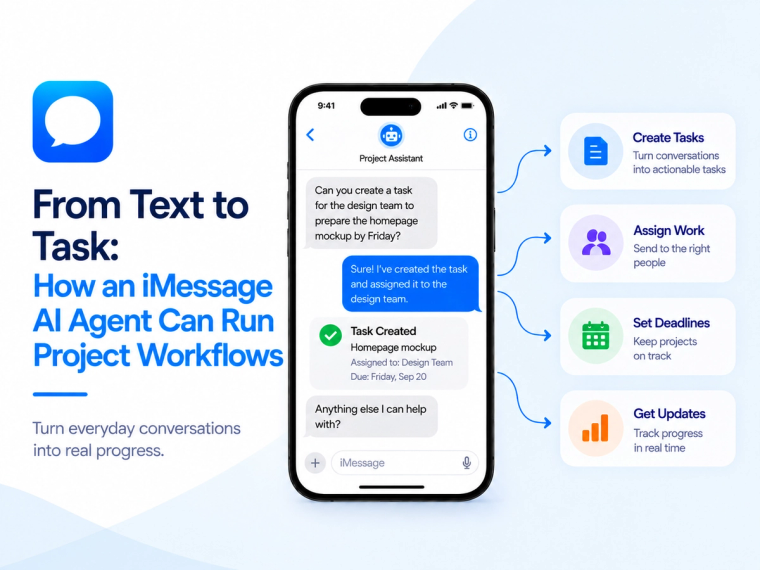
Learn how an iMessage AI agent can capture tasks, check project status, update issues and route work through Jira, Linear, ClickUp and other project systems.
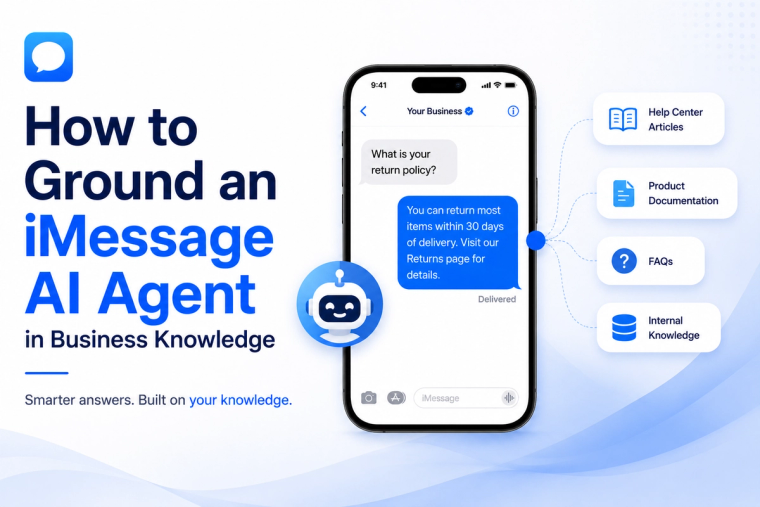
Learn how to prepare, structure, test and maintain business knowledge so an iMessage AI agent gives accurate answers and knows when not to guess.
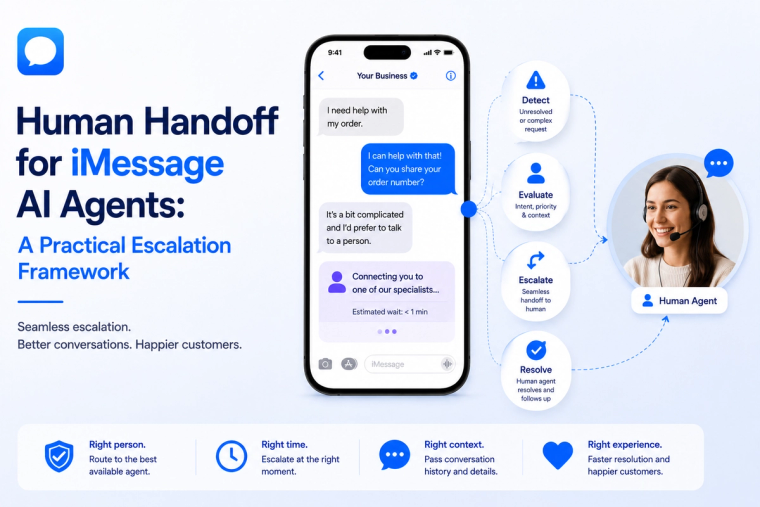
Design a reliable human handoff for an iMessage AI agent with clear triggers, ownership, context transfer, CRM routing and safe conversation recovery.