Best iMessage API for Business: 2026 Comparison
MessageBlue vs SendBlue vs LoopMessage vs BlueBubbles — an honest breakdown of the iMessage API landscape, and how to pick the right one for reliability, spam protection and enterprise isolation.
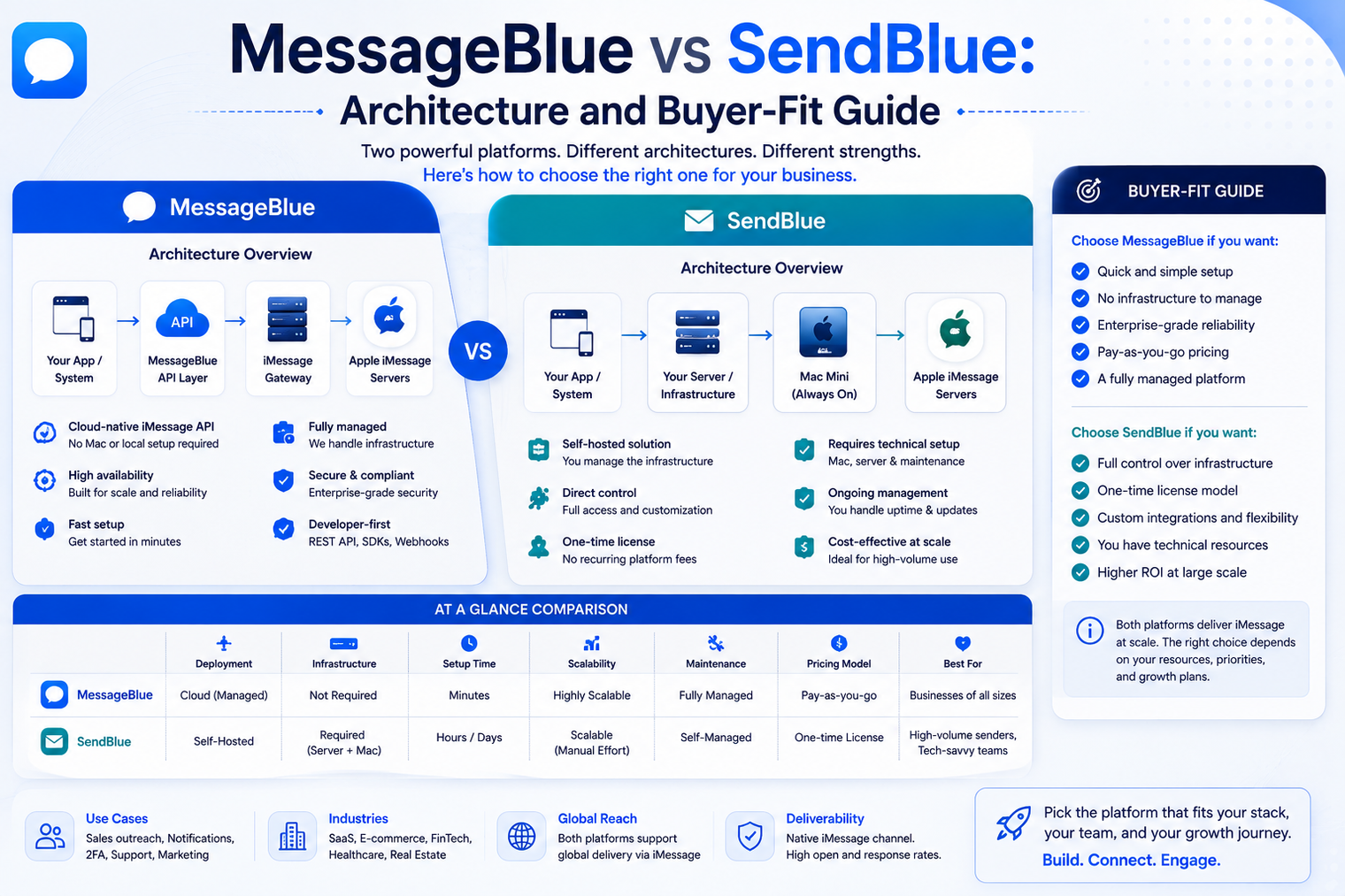
• MessageBlue is a strong fit when the project centers on AI agents, existing-number automation or deployment inside a customer-controlled environment.
• Sendblue is a strong fit when the team wants a low-friction sandbox, a lower published entry price per dedicated line or broad sales and CRM integrations.
• Both platforms publish REST API, webhook and rich messaging capabilities, so the decision should include reliability behavior, event design, number lifecycle, support and operational controls.
• Public pricing and feature lists change. High-intent buyers should verify the current plan, limits and contract language before choosing.
• A real proof of concept should test inbound replies, retries, fallback, media, handoff and observability, not only a successful outbound send.
MessageBlue and Sendblue both give businesses a way to send and receive iMessages through software, but they do not present the same product center of gravity. A buyer looking only at a feature checklist may miss the more important question: which platform fits the architecture, workflow and operating model the team is actually building?
MessageBlue is positioned around AI agents, programmable conversations, existing-number automation and private enterprise deployment. Sendblue presents an accessible iMessage API, a free sandbox, sales and CRM workflows, dedicated lines and an enterprise tier for higher-volume use.
This comparison does not declare one platform best for every buyer. It explains the practical differences, identifies where each product appears strongest based on its public website as of August 1, 2026 and gives teams a proof-of-concept framework for making a defensible decision.
Two platforms with different product centers
MessageBlue describes itself as an iMessage infrastructure platform for AI agents and revenue teams. Its public product story begins with an agent or application that needs a real messaging layer, then expands into no-code building, APIs, bring-your-own-number workflows and private deployment.
The clearest differentiator is the focus on LLM iMessage integration. MessageBlue states that teams can connect an LLM or agent framework of their choice, receive inbound messages through webhooks and send responses through the platform.
The public enterprise material also emphasizes customer cloud, VPC and on-premises deployment options. That makes MessageBlue especially relevant when messaging is part of a larger security, data residency or infrastructure-control discussion.
Sendblue presents itself as an iMessage API for developers and a business texting platform for sales teams. Its site highlights a free sandbox, dedicated production lines, Node.js and Python examples, cURL, a command-line tool, webhooks, delivery receipts and CRM connectivity.
The official Sendblue website also promotes features such as contact card delivery, FaceTime Audio, group messaging and automatic iMessage, RCS or SMS routing, subject to the current product plan and documented limits.
For teams that want to test quickly with a small contact set, Sendblue's free sandbox and public self-serve entry path can reduce initial buying friction.
| Evaluation area | MessageBlue | Sendblue | Buyer implication |
|---|---|---|---|
| Primary positioning | AI agents, developer infrastructure, revenue workflows and private enterprise deployment. | iMessage API, sales workflows, CRM integrations and business texting. | Choose the product whose public roadmap and support model align with the main use case. |
| Developer access | REST API, SDK positioning, webhooks with retry and replay claims, sandbox and model-agnostic agent integration. | REST API, Node.js and Python examples, cURL, CLI, webhooks, callbacks and a free sandbox. | Test the actual event schema, SDK quality and debugging experience. |
| AI agent path | Dedicated AI-agent product and a separate no-code agent builder. | AI Agent plan and agent-builder experience, with strong API and workflow emphasis. | Compare prompt, knowledge, tool, memory and handoff needs rather than the label alone. |
| Number strategy | Promotes provisioning and automation of existing iMessage numbers, including team-line use cases. | Promotes dedicated lines and states that numbers can be ported and enabled for iMessage. | Confirm ownership, porting, coexistence with manual use and migration requirements. |
| Sales and CRM | Names HubSpot, Salesforce and Zapier, with reply-triggered and representative-number workflows. | Publishes CRM integrations including HubSpot, Salesforce, GoHighLevel, Close, Monday and Follow Up Boss. | Sendblue appears broader on published native integration breadth; MessageBlue emphasizes number-level automation and workflow control. |
| Enterprise deployment | Publicly promotes private managed, customer cloud or VPC, on-premises and air-gapped options. | Publicly promotes an enterprise tier, SOC 2 and HIPAA-related positioning, dedicated support and multiple lines. | MessageBlue is more explicit about customer-controlled deployment models on reviewed public pages. |
| Published entry path | Paid startup and production plans are shown, plus contact-sales private cloud. | Free sandbox, a published per-line AI Agent plan and custom enterprise pricing. | Sendblue has the lower publicly listed entry point as of the comparison date. |
| Best initial fit | Agent products, existing-number automation and security-led architecture. | Fast API evaluation, sales integrations and cost-sensitive dedicated-line testing. | Validate fit with a narrow real workflow before signing a larger contract. |
Both platforms allow applications to send an outbound message and receive inbound activity through webhooks. That common description hides the details that determine production reliability.
MessageBlue's public pages emphasize signed webhooks, automatic retries, replay and model-agnostic integration. Developers evaluating the platform should inspect the current iMessage API for developers and confirm authentication, event ordering, retry intervals, replay tools, idempotency guidance and error codes.
Sendblue publishes direct code samples, a free sandbox and a CLI, which can make the first test straightforward. Its public site also states that production plans include webhooks and callbacks.
A fair comparison should intentionally fail the receiving endpoint, return non-success status codes, process duplicate events and reconnect after downtime. The winning developer experience is the one that makes recovery observable and predictable, not merely the one that produces the shortest sample request.
An AI agent needs more than a messaging endpoint. It needs conversation state, model access, knowledge, tool permissions, safety rules, latency management and a clear human handoff.
MessageBlue's differentiation is that this architecture is central to its positioning. The platform separates the intelligence layer from the delivery layer and encourages teams to bring the model or framework that fits their product. It also offers a no-code route for teams that want to configure a model, prompt and business knowledge without first building webhook infrastructure.
Sendblue supports AI-agent use cases and offers an AI Agent plan. Its public developer path focuses on API access, webhooks, SDK examples and the ability to connect the messaging layer to application logic.
The correct choice depends on where the team wants product responsibility to sit. A team seeking a platform family that spans no-code agents, custom LLM workflows and private deployments may prefer MessageBlue. A team that already has the agent stack and mainly needs an accessible messaging API may find Sendblue's entry path attractive.
Number strategy can change the customer experience and the migration plan. A new dedicated number is easier to isolate, monitor and retire, but customers must learn it. An existing number preserves recognition, but the system must coordinate manual texting, automation, ownership and handoff.
MessageBlue makes this a named product capability. Its programmable iMessage number workflow is designed around connecting a number a founder or representative already uses and allowing automation to operate alongside human messaging.
Sendblue states that it can port a number and enable it with iMessage, with additional setup time. Porting and same-line coexistence are not identical operating models, so buyers should ask precise questions.
• Will the existing carrier service remain active?
• Can the person continue texting manually from the same number?
• What prevents an automated reply while a human is typing?
• What happens to old conversation history?
• How is number ownership transferred at contract end?
• What is the rollback plan if the migration is unsuccessful?
Sendblue publishes a broad set of sales integrations and presents CRM-based iMessage outreach as a major use case. Its public site names platforms beyond HubSpot and Salesforce, which may reduce custom integration work for teams already using those systems.
MessageBlue also supports sales and CRM workflows, but its product story places more emphasis on reply-triggered logic, representative numbers and the ability to connect a conversation to AI or custom application behavior.
Native integration count should not be the only criterion. A buyer should test whether the integration can write inbound replies to the correct record, stop a sequence, preserve ownership, handle opt-outs, attach media and provide enough metadata for attribution.
This is the most significant public positioning difference. MessageBlue describes private managed cloud, deployment into a customer's AWS, GCP or Azure environment, and on-premises or air-gapped options.
Teams with data residency, private-networking or customer-managed key requirements can review MessageBlue's private iMessage API deployment options. The relevant question is not only whether the environment is isolated. It is how logs, backups, telemetry, support access, updates and disaster recovery are handled.
Sendblue's public site emphasizes an enterprise plan, SOC 2 Type II certification and HIPAA-eligible positioning. On the reviewed public pages, it does not describe the same range of customer-cloud or on-premises deployment models. This does not prove that a custom arrangement is unavailable. It means a security-led buyer should ask Sendblue directly and require the answer in architecture and contract documents.
Pricing is time-sensitive, but it matters in a vendor comparison. As of August 1, 2026, MessageBlue's public site showed paid startup and production plans beginning above Sendblue's publicly listed AI Agent line price, with private cloud handled through sales. Sendblue showed a free sandbox, a $100 per month AI Agent plan per dedicated line and custom enterprise pricing.
The lower entry price can make Sendblue attractive for a small pilot. However, monthly price is not the complete cost. Compare setup fees, line limits, inbound and outbound restrictions, contact limits, media, support, fallback, CRM access, enterprise controls and the engineering work required to close any gaps.
For MessageBlue, the higher published plans may make more sense when the buyer values agent-specific tooling, high-availability positioning, existing-number automation or private deployment. For Sendblue, the lower entry point may be the better economic fit when the team needs one dedicated line and standard API or CRM workflows.
• The core product is an AI agent that customers will text, and the team wants the messaging layer designed around that architecture.
• The business needs to automate a number customers already recognize and coordinate human and automated activity on the line.
• The deployment may need to run in a customer cloud, VPC, on-premises environment or other isolated architecture.
• The team wants a path from no-code agent configuration to custom APIs and tools within the same product family.
• The buying decision is driven more by control, isolation and workflow design than by the lowest published entry price.
• The team wants a free sandbox and a low published per-line production entry point.
• The main requirement is adding iMessage to an existing application through familiar API calls, SDK examples or a CLI.
• The sales stack already uses one of Sendblue's published native CRM integrations.
• Features such as contact cards, FaceTime Audio or Sendblue's specific multi-channel routing are important to the workflow.
• The organization needs a managed service and does not currently require a publicly documented BYOC or on-premises deployment option.
A one-message demo will not reveal enough to choose between vendors. Use the same business workflow on both platforms and score the complete lifecycle.
| Test | What to do | What to record |
|---|---|---|
| Provisioning | Create the sandbox or production line and configure credentials. | Time, manual steps, approvals, documentation gaps and support required. |
| Outbound send | Send text and supported media to eligible and ineligible recipients. | Latency, channel result, fallback behavior, message ID and error clarity. |
| Inbound reply | Reply with text, media, reactions and unexpected content. | Webhook payload, ordering, conversation linkage and unsupported cases. |
| Failure recovery | Disable the endpoint, return errors and replay events. | Retry schedule, duplicate handling, replay controls and observability. |
| Human handoff | Escalate from automation to a named person. | Ownership, notifications, sequence stop, transcript access and collision prevention. |
| CRM update | Write the conversation to the target contact or opportunity. | Field mapping, media, timestamps, attribution and bidirectional sync. |
| Number lifecycle | Document onboarding, migration and cancellation. | Ownership, porting, coexistence, export and rollback. |
| Security review | Request architecture, retention and access documentation. | Data flow, encryption, logs, support access, certifications and deployment options. |
| Commercial review | Model the first year at expected usage. | Model the first year at expected usage. |
If the system must run inside your cloud, VPC or on-premises environment, evaluate MessageBlue's enterprise path first and ask Sendblue whether an equivalent supported arrangement is available.
If manual texting and automation must coexist on an existing iMessage number, test MessageBlue's bring-your-own-number workflow. If a new dedicated line or a ported number is acceptable, evaluate both providers.
If the project needs no-code agent configuration and custom LLM expansion, MessageBlue has a clearly published path. If the team already owns the agent or application logic, compare API and webhook behavior directly.
If a required CRM has a native Sendblue integration and MessageBlue would require custom work, quantify that difference. If representative-number control and custom reply actions matter more, test MessageBlue's workflow model.
The lower entry price is valuable only when the plan supports the required outbound behavior, contact volume, fallback, support and integration depth. Eliminate options that fail the workflow before comparing price.
A general ranking evaluates several vendors against broad criteria. A two-vendor comparison should go deeper into buyer fit, migration risk and operating model.
Teams that still need to survey the wider market can read the current iMessage API comparison for business. After narrowing the list, use the proof-of-concept framework in this article to validate the final choice.
MessageBlue is the stronger candidate when AI-agent architecture, an existing trusted number or private deployment is central to the project. Sendblue is the stronger candidate when a team wants fast self-serve testing, a lower public entry price, broad CRM integration options or Sendblue-specific communication features.
The final choice should come from a controlled proof of concept, a security review and a one-year commercial model. Select the platform that handles the entire conversation reliably, including replies, failures, handoff and data controls, rather than the platform that only looks best in the first API call.
This comparison reflects public product information reviewed on August 1, 2026. Pricing, plan limits, integrations, compliance statements and deployment options can change. Recheck both vendors' current documentation, security materials and contracts immediately before publication or purchase.
Yes. Both platforms provide programmatic iMessage capabilities, but MessageBlue differentiates through AI-agent positioning, existing-number automation and explicit private deployment options.
As of August 1, 2026, Sendblue listed a free sandbox and a $100 per month AI Agent plan per dedicated line. MessageBlue listed higher paid startup and production plans. Verify current prices and limits before purchase.
MessageBlue is more explicitly centered on AI agents and model-agnostic integration. Sendblue also supports AI-agent use cases and may be attractive when the team already has the agent logic and wants a lower-cost messaging entry point.
Sendblue publishes a broader native CRM integration list. MessageBlue emphasizes representative numbers, reply-triggered workflows and existing-number automation. The better option depends on the CRM, number model and workflow depth.
Both publicly describe REST API and webhook-based two-way messaging. Teams should compare current documentation, event behavior, retry handling, limits and supported features.
MessageBlue publicly describes customer-cloud, VPC, on-premises and air-gapped deployment paths. Sendblue's reviewed public pages emphasize managed enterprise and compliance capabilities rather than the same published deployment range.
No. Feature labels do not reveal reliability, edge cases, limits, support quality or migration effort. Run the same production-like workflow on both platforms.
Connect any LLM to a real blue-bubble number and go live in minutes.
Deploy an AgentMessageBlue vs SendBlue vs LoopMessage vs BlueBubbles — an honest breakdown of the iMessage API landscape, and how to pick the right one for reliability, spam protection and enterprise isolation.
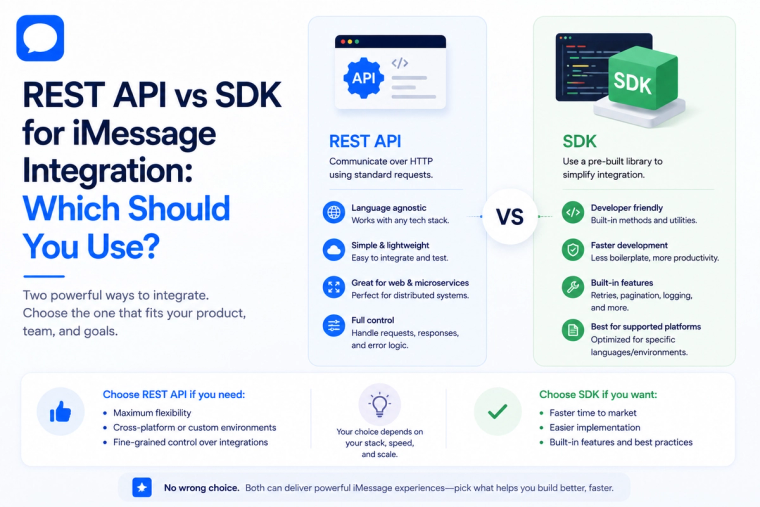
Compare an iMessage REST API with an SDK across control, portability, debugging, upgrades and team workflow. Choose the right integration path for your product.
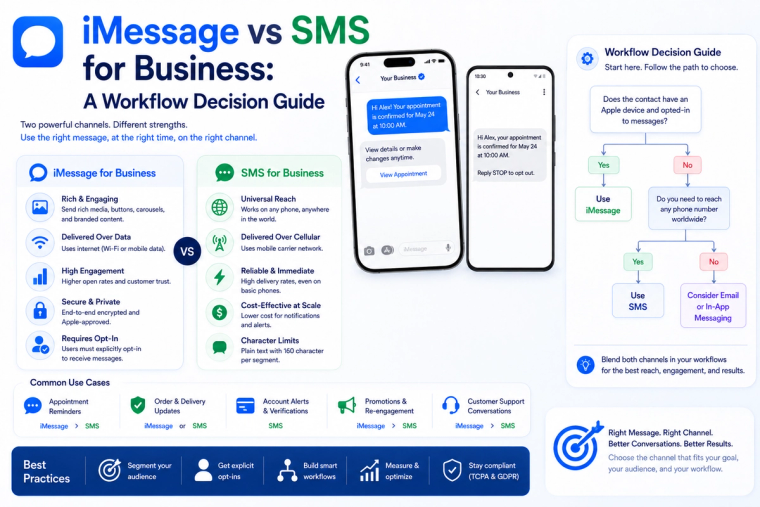
Compare iMessage and SMS for business messaging across reach, automation, customer experience, compliance, fallback and cost. Choose the right channel for each workflow.