Best iMessage API for Business: 2026 Comparison
MessageBlue vs SendBlue vs LoopMessage vs BlueBubbles — an honest breakdown of the iMessage API landscape, and how to pick the right one for reliability, spam protection and enterprise isolation.
• SMS is the broadest default channel, while iMessage is a richer option for recipients who can receive it.
• The best channel depends on the job. Urgent universal alerts, conversational sales follow-up, AI assistance and account notifications do not have identical requirements.
• A business should evaluate the full workflow, including eligibility detection, reply handling, identity, routing, human handoff and CRM updates.
• iMessage does not use the US A2P 10DLC carrier path, but businesses still need consent, relevance, clear identity and responsible opt-out handling.
• A hybrid design can start with iMessage for eligible users and use SMS or RCS fallback when the richer channel is unavailable.
Choosing a business messaging channel is not simply a decision between blue and green bubbles. It is a decision about reach, interaction design, sender identity, automation, compliance, cost and what should happen after a customer replies.
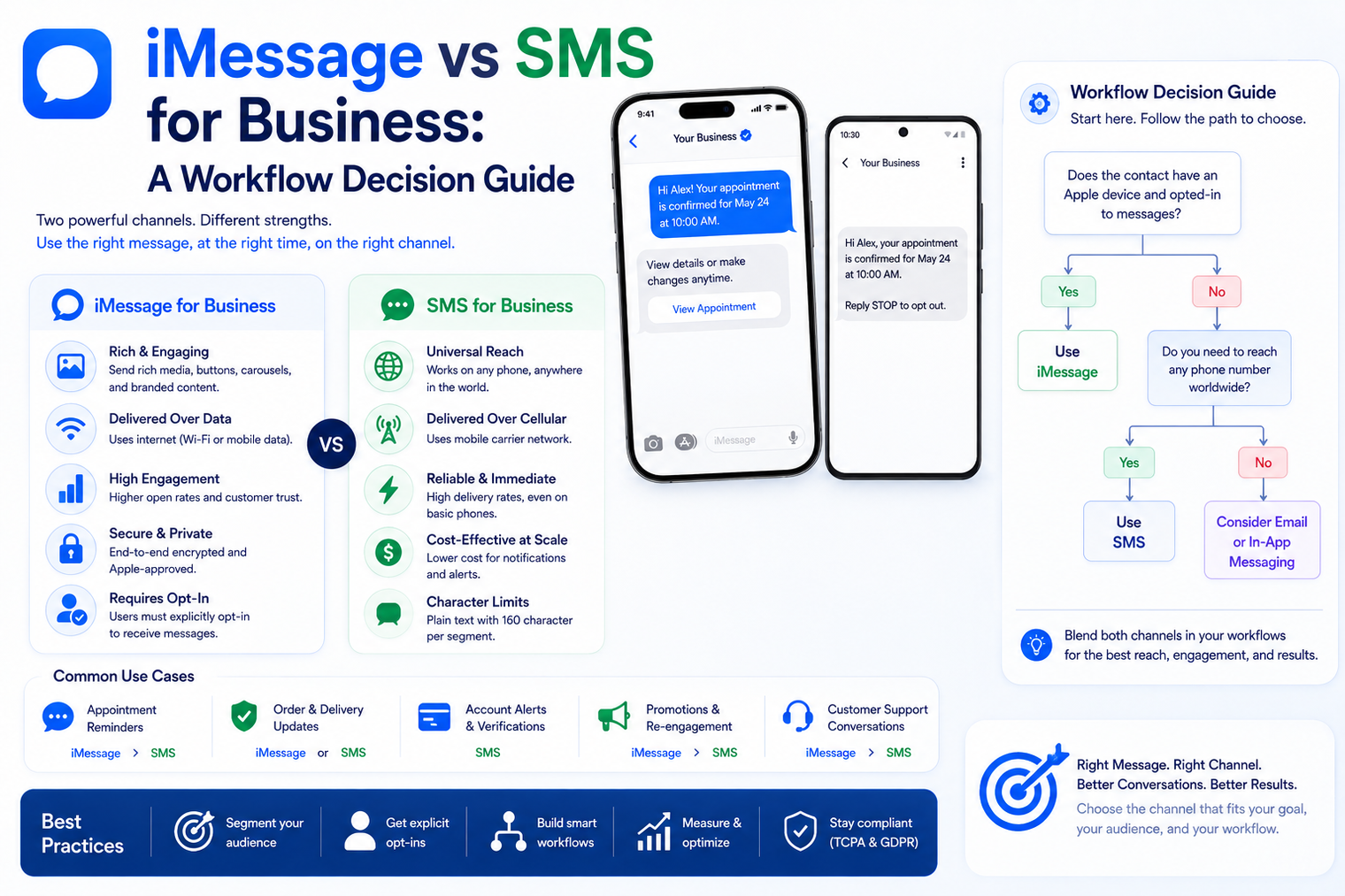
SMS remains valuable because it works across nearly every mobile phone. iMessage can create a richer conversation for eligible Apple users, especially when a business needs two-way dialogue, media, engagement signals or an AI agent. The strongest messaging strategy often uses both channels, with clear routing rules instead of treating one as a universal replacement for the other.
This guide compares iMessage vs SMS for business from a workflow perspective. It explains where each channel fits, where it creates limitations and how to design a fallback path that protects the customer experience.
Apple Messages can carry several message types. Apple explains that iMessages travel over Wi-Fi or cellular data and appear as blue bubbles, while SMS, MMS and RCS messages appear as green bubbles. That visual difference matters to users, but it is only the visible layer of a deeper technical distinction.
At the workflow level, iMessage and SMS use different transport systems, support different interaction signals and create different implementation requirements. A business comparing the two should begin with the official Apple explanation of iMessage, RCS and SMS, then map those channel differences to its own customer journey.
The question is not, “Which channel is better?” The useful question is, “Which channel gives this customer the right experience for this specific message, and what should happen if that channel is unavailable?”
| Decision area | iMessage | SMS |
|---|---|---|
| Recipient reach | Available when the recipient can receive iMessage on a supported Apple device and the service is active. | Available across a much broader range of mobile devices and carrier networks. |
| Network path | Uses internet connectivity through Apple's messaging service. | Uses carrier messaging infrastructure. |
| features | Can support richer media and interaction signals such as read state, typing activity and reactions, depending on the implementation. | Core text delivery is widely supported, but advanced interaction features are limited or vary by carrier and MMS support. |
| Business onboarding | Does not use the US A2P 10DLC SMS registration pathway. | US application-to-person traffic over a 10-digit long code typically requires A2P 10DLC registration. |
| Fallback need | Requires another route when the recipient cannot receive iMessage. | Often serves as the broad fallback route. |
| Best default use | High-value conversations, AI agents, service interactions and personalized follow-up for eligible recipients. | Universal notifications, verification, broad audience reach and cases where device eligibility is unknown. |
If every recipient must receive the message regardless of device type, SMS has a clear advantage. This is why SMS remains common for one-time passcodes, critical account alerts, delivery notices and reminders. A channel strategy should not exclude a customer simply because the customer is not using an Apple device.
iMessage can still be the preferred first route for an eligible segment, but the workflow needs a defined fallback. Do not make the customer journey depend on a single channel unless the audience is intentionally limited.
A one-way notice has different requirements from an ongoing exchange. If the message only needs to deliver a short fact, SMS may be sufficient. If the customer is expected to ask questions, share details, react, confirm, reschedule or continue over several days, iMessage can support a more conversational experience.
For software teams, this is where a programmable iMessage platform becomes relevant. The value is not only sending a message. It is receiving the reply, attaching it to the correct conversation and triggering the next application action.
Read state, typing activity, reactions, images, videos and voice content can make a conversation feel more natural. These features are useful when an AI assistant is preparing an answer, a customer is reviewing a product, a guest is changing a reservation or a representative needs to know whether a message was seen.
Rich features should support the task rather than decorate it. A shipping delay alert does not become more useful merely because it contains an animation. Choose iMessage when the richer interaction improves clarity, trust or the ability to complete the workflow.
Customer recognition can be more important than channel novelty. A founder, adviser, account manager or sales representative may already have a number that customers know. Keeping that identity can reduce confusion and preserve continuity across manual and automated messages.
Businesses exploring this model should evaluate whether they can use an existing number for iMessage workflows while retaining clear rules for manual replies, automation ownership and human takeover.
The quality of a messaging program is often determined after the first response. A reply may need to stop a sequence, update a CRM record, notify an owner, call an AI model, create a ticket or schedule an appointment. If the system cannot perform the next step reliably, the choice of channel will not solve the operational problem.
For both SMS and iMessage, use a conversation identifier, store message state and make event processing idempotent so retries do not create duplicate actions. The platform should also preserve context when a conversation changes channels.
US business SMS sent through application-to-person 10-digit long codes generally requires brand and campaign registration. That process improves accountability and provides carriers with information about the sender and use case. It also adds setup work, campaign rules and ongoing carrier considerations.
The Twilio A2P 10DLC overview explains the registration model for US SMS traffic. iMessage does not use that carrier registration path, but this difference should never be presented as permission to message people without consent or relevance.
Channel selection does not remove legal and ethical messaging obligations. Businesses should identify themselves, message people for an expected purpose, respect frequency limits and process reasonable stop requests. The consent standard may vary by message type, jurisdiction, technology and whether the content is informational or promotional.
The safest operational approach is to maintain a channel preference and consent record for each contact, keep proof of the source and date, and make suppression effective across every connected workflow. A customer who opts out should not re-enter through a separate automation.
Comparing only the unit cost of a message can produce the wrong decision. A useful cost model includes platform fees, per-message or per-line charges, carrier fees, registration work, engineering time, support effort and the cost of conversations that fail to reach a useful outcome.
Measure cost per delivered message for notifications, cost per qualified reply for sales, cost per resolved conversation for support and cost per completed action for transactional workflows. The correct metric depends on the job.
Messaging systems process message content, phone numbers, timestamps, delivery events and conversation metadata. A buyer should review retention, access control, encryption, webhook security, audit history, support access and deployment boundaries.
For a regulated or security-sensitive workflow, channel choice is only one architecture decision. The organization also needs to know where application data, message logs, backups and observability records are stored.
| Workflow | Preferred starting point | Why | Fallback or control |
|---|---|---|---|
| One-time passcodes | SMS or a dedicated verification service | Broad reach and a short, universal interaction. | Use fraud controls, expiration and resend limits. |
| Appointment reminders | Hybrid | iMessage can support confirmation or rescheduling, while SMS preserves reach. | Route based on eligibility and keep one appointment state. |
| Sales follow-up | iMessage for eligible, consented contacts | The task depends on a reply and ongoing relationship context. | Use SMS only when appropriate, stop sequences on reply and hand off to the representative. |
| Order and service updates | Hybrid | Some updates are notices, while others trigger questions. | Use channel-aware templates and preserve the order context. |
| AI concierge or support agent | iMessage for eligible users | The conversation benefits from rich two-way interaction and continuity. | Provide SMS or web support for non-iMessage users and a human escalation route. |
| Emergency or safety alerts | Multi-channel | Reach and speed are more important than a single experience. | Use approved redundant channels and avoid relying on read receipts alone. |
| Global customer messaging | SMS, RCS or regional channels | iMessage eligibility and device share vary by market. | Use country-specific routing and compliance logic. |
| Sensitive enterprise workflow | Architecture-led choice | Data boundary, retention, access and audit requirements may dominate the channel decision. | Complete security and legal review before deployment. |
A hybrid model does not mean sending the same message through every channel. It means choosing the best available route in a predictable order and preserving one customer state.
• Check whether the recipient is eligible for iMessage before sending.
• Use iMessage when the workflow benefits from a richer two-way conversation.
• Use SMS or RCS when iMessage is unavailable and the message is appropriate for fallback.
• Adapt the content to the receiving channel instead of copying unsupported media or interaction cues.
• Write all events into one conversation record so the customer does not receive duplicate or contradictory messages.
The routing decision should be invisible to the customer. The customer should see one coherent conversation, not the internal complexity of channel detection, retries and provider logic.
Keep the business event, such as “appointment changed,” separate from the channel template. The event should select the appropriate iMessage, RCS or SMS version.
Use one key for the business event across every attempted channel. This reduces the risk that a retry sends a second customer-facing message.
Decide how long the system should wait for a channel result before using another route. The timeout should match the urgency of the workflow.
A reply received after fallback must still reach the correct account, representative, ticket or agent. Do not create isolated inboxes that fragment context.
Store which channel was used, whether the message was delivered, whether the customer replied and what action followed. This supports troubleshooting and performance analysis.
Run a controlled pilot with one narrow workflow before replacing a large messaging program. Use the same audience rules and business objective, then compare outcomes over a meaningful period.
• Eligibility rate: the share of contacts who can receive the preferred channel.
• Delivery outcome: delivered, failed, filtered, expired or moved to fallback.
• Reply quality: useful responses, not only any response.
• Time to first meaningful reply and time to completed action.
• Human workload created by escalations, unclear replies and exceptions.
• Opt-out, complaint and suppression rates.
• Cost per completed business outcome.
• Duplicate, out-of-order and orphaned conversation events.
The winning channel is the one that improves the complete workflow without creating unacceptable reach gaps, compliance risk or operational burden.
MessageBlue positions iMessage as a programmable conversation layer for AI agents, developers and revenue teams. A business can use a AI agents over iMessage to send messages, receive replies through webhooks and connect the conversation to application logic.
For revenue use cases, the platform also supports business iMessage automation for sales teams, including reply-triggered actions and CRM-connected follow-up. The design goal should remain a relevant conversation with a clear owner, not bulk outreach.
Where supported, SMS or RCS fallback can keep the workflow moving when iMessage is unavailable. Teams should confirm current fallback behavior, geography, carrier support, limits and plan requirements before launch.
The most effective business messaging architecture does not force every customer into the same channel. It uses the richest appropriate experience when available, preserves a dependable fallback and connects every reply to the next useful action.
Start with one workflow, define the customer promise and decide how the conversation should continue when the preferred route is unavailable. That approach produces a better result than choosing a channel only because it looks familiar or appears inexpensive.
Neither channel is universally better. iMessage is often stronger for eligible users when the workflow needs a rich two-way conversation. SMS is stronger when broad device reach is the primary requirement.
Yes. A common design uses iMessage as the preferred route for eligible users and SMS or RCS as fallback. The system should preserve one conversation state and prevent duplicate sends.
iMessage is not an SMS carrier channel, so it does not use the US A2P 10DLC registration process. This does not remove consent, anti-spam, identification or opt-out responsibilities.
Good candidates include AI concierges, support conversations, appointment changes, personalized sales follow-up, product questions and workflows where a reply triggers an operational action.
Choose SMS first when universal reach, device independence or a short transactional notice matters more than rich interaction.
Yes, if the messaging platform and application are designed for fallback. The content, timing and reply routing should be adapted to the receiving channel.
Compare completed business outcomes, not only sends or opens. Track delivery, meaningful replies, resolution time, conversion, complaints, human workload and cost per outcome.
Connect any LLM to a real blue-bubble number and go live in minutes.
Deploy an AgentMessageBlue vs SendBlue vs LoopMessage vs BlueBubbles — an honest breakdown of the iMessage API landscape, and how to pick the right one for reliability, spam protection and enterprise isolation.
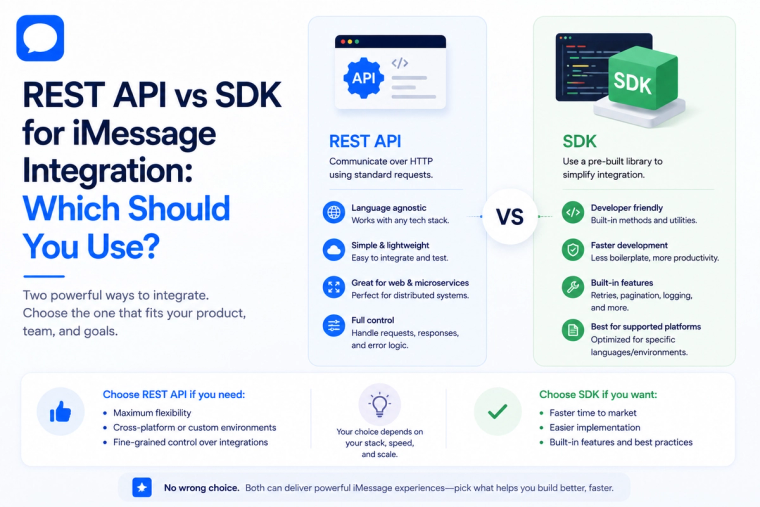
Compare an iMessage REST API with an SDK across control, portability, debugging, upgrades and team workflow. Choose the right integration path for your product.
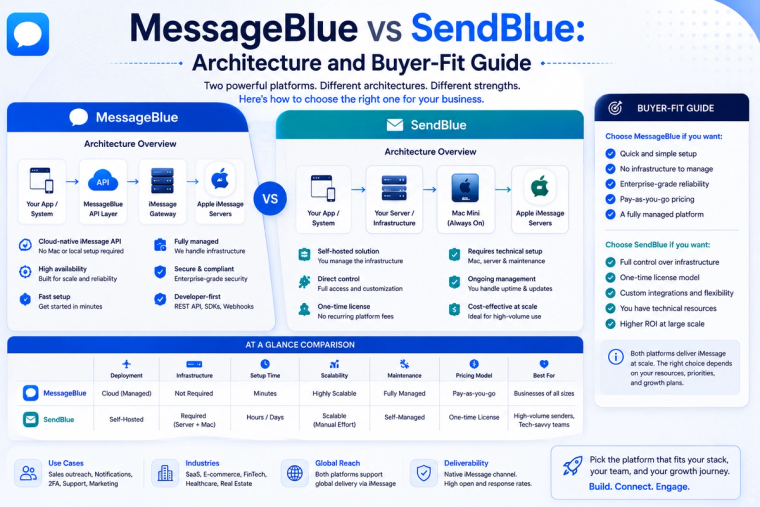
Compare MessageBlue and SendBlue across AI agents, APIs, CRM workflows, number options, enterprise deployment and pricing. Choose the right iMessage platform for your use case.